Honda i-DCD hybrid: when the 12 V battery stops charging
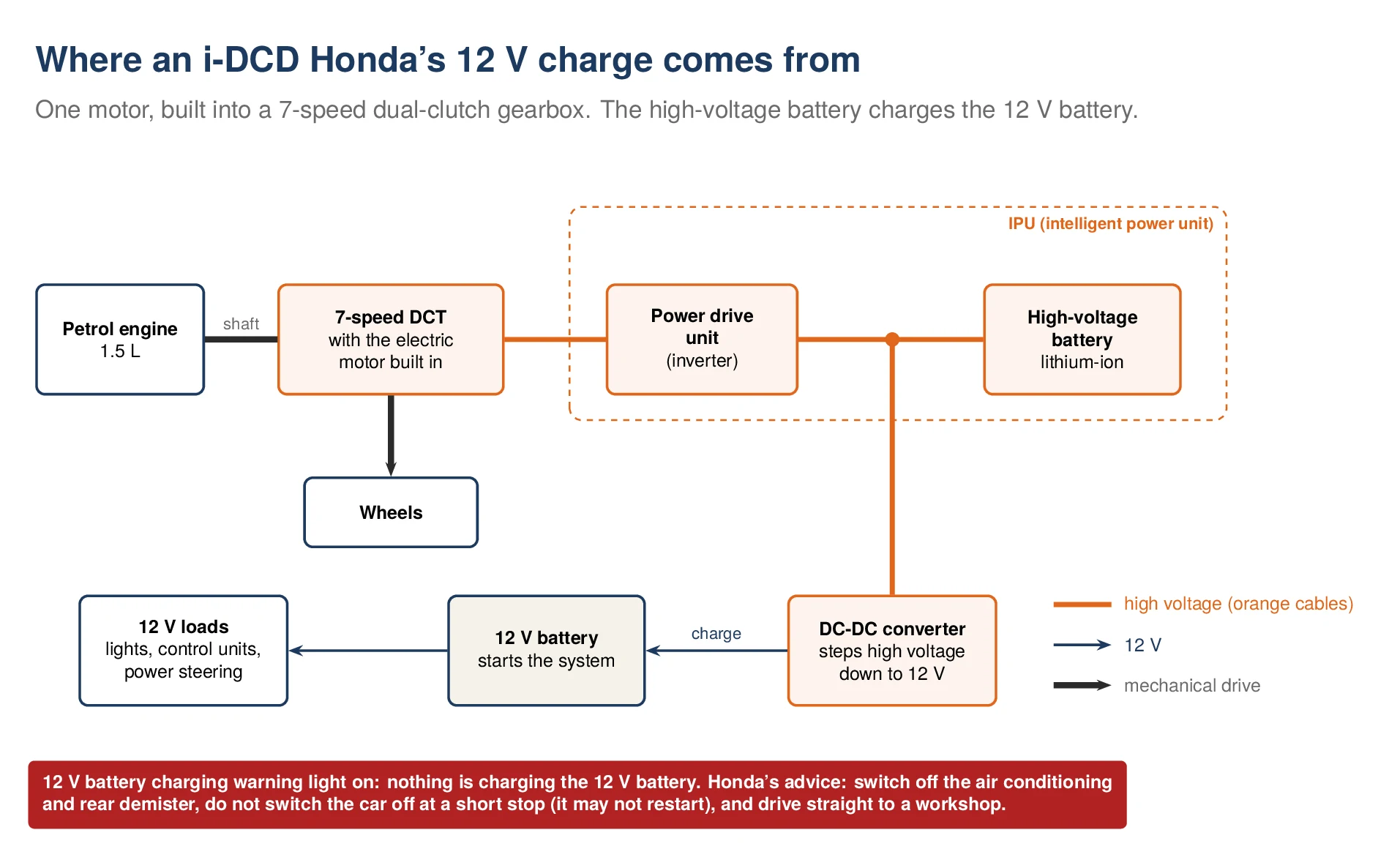
From late 2013, Honda's small hybrids moved from IMA to a new system called SPORT HYBRID i-DCD. If you drive or repair a Fit Hybrid, an early Vezel Hybrid, a Grace, a Shuttle Hybrid or a Freed Hybrid imported from Japan, this is likely the system in it. Like the older IMA cars, it charges its 12 V battery from the high-voltage battery, so a fault on the hybrid side can leave the 12 V battery with no charge.
This article explains how i-DCD works, what its warning lights mean, what to check and in what order, and which faults Honda itself has recalled these cars for.
Which Hondas use i-DCD
i-DCD stands for Intelligent Dual Clutch Drive. In Japan it was used in:
| Model | On sale in Japan | Chassis number starts |
|---|---|---|
| Fit Hybrid (third generation) | September 2013 to February 2020 | GP5 or GP6 |
| Vezel Hybrid (first generation) | December 2013 to April 2021 | RU3 or RU4 |
| Grace hybrid sedan | from December 2014 | GM4 or GM5 |
| Jade Hybrid | from February 2015 | FR4 |
| Shuttle Hybrid | from May 2015 | GP7 or GP8 |
| Freed and Freed+ Hybrid (second generation) | September 2016 to June 2024 | GB7 or GB8 |
The model code on a Japanese export certificate helps here. Honda's hybrids carry the letters AA in the prefix, as in DAA-GP5 for a Fit Hybrid. The petrol versions carry BA instead, as in DBA- or 6BA-.
Two other generations of Honda hybrid are common on Zambian roads, and neither works like i-DCD:
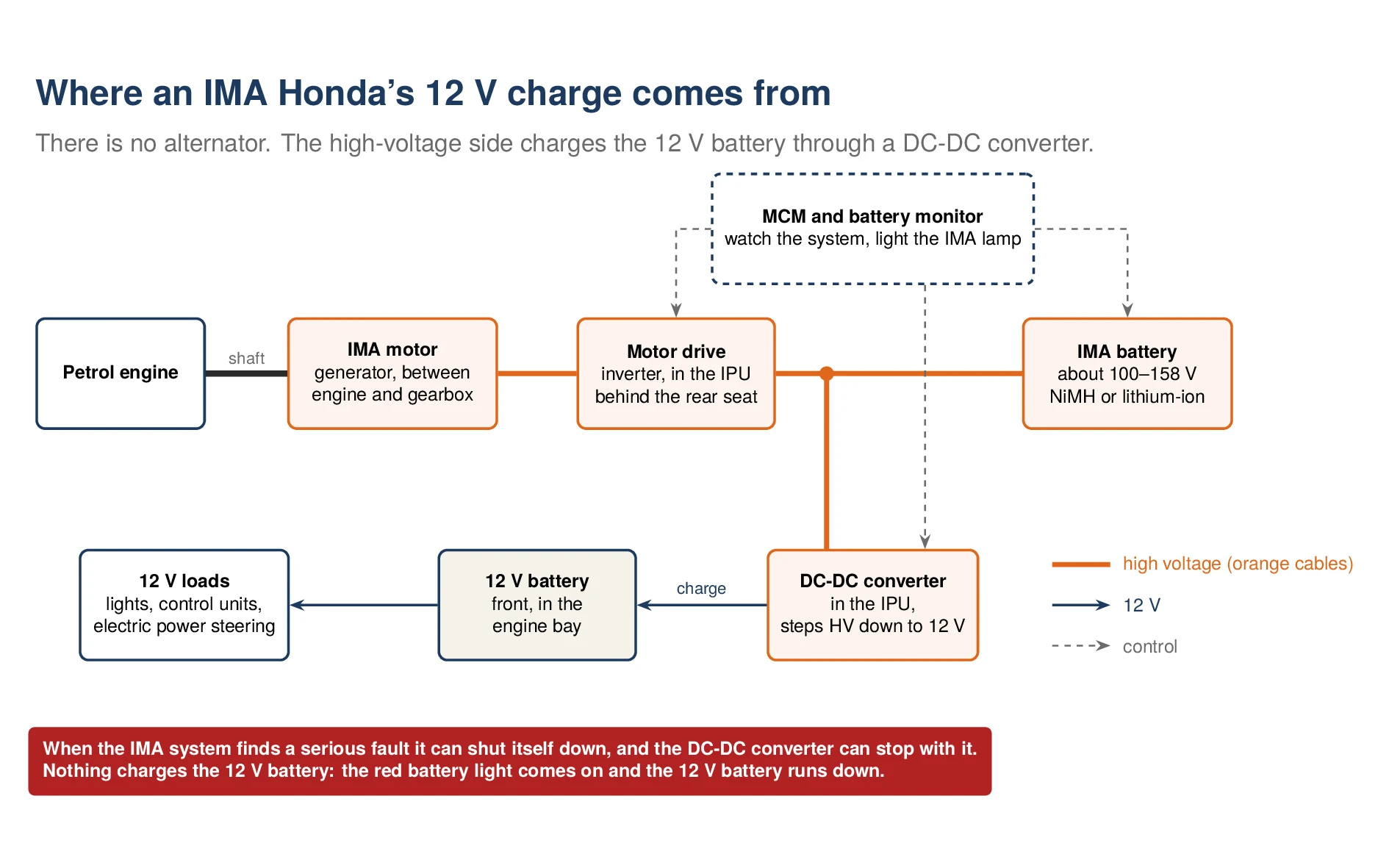
- The cars before this generation used IMA. These include the 2010–2013 Fit Hybrid, the Fit Shuttle Hybrid and the first Freed Hybrid.
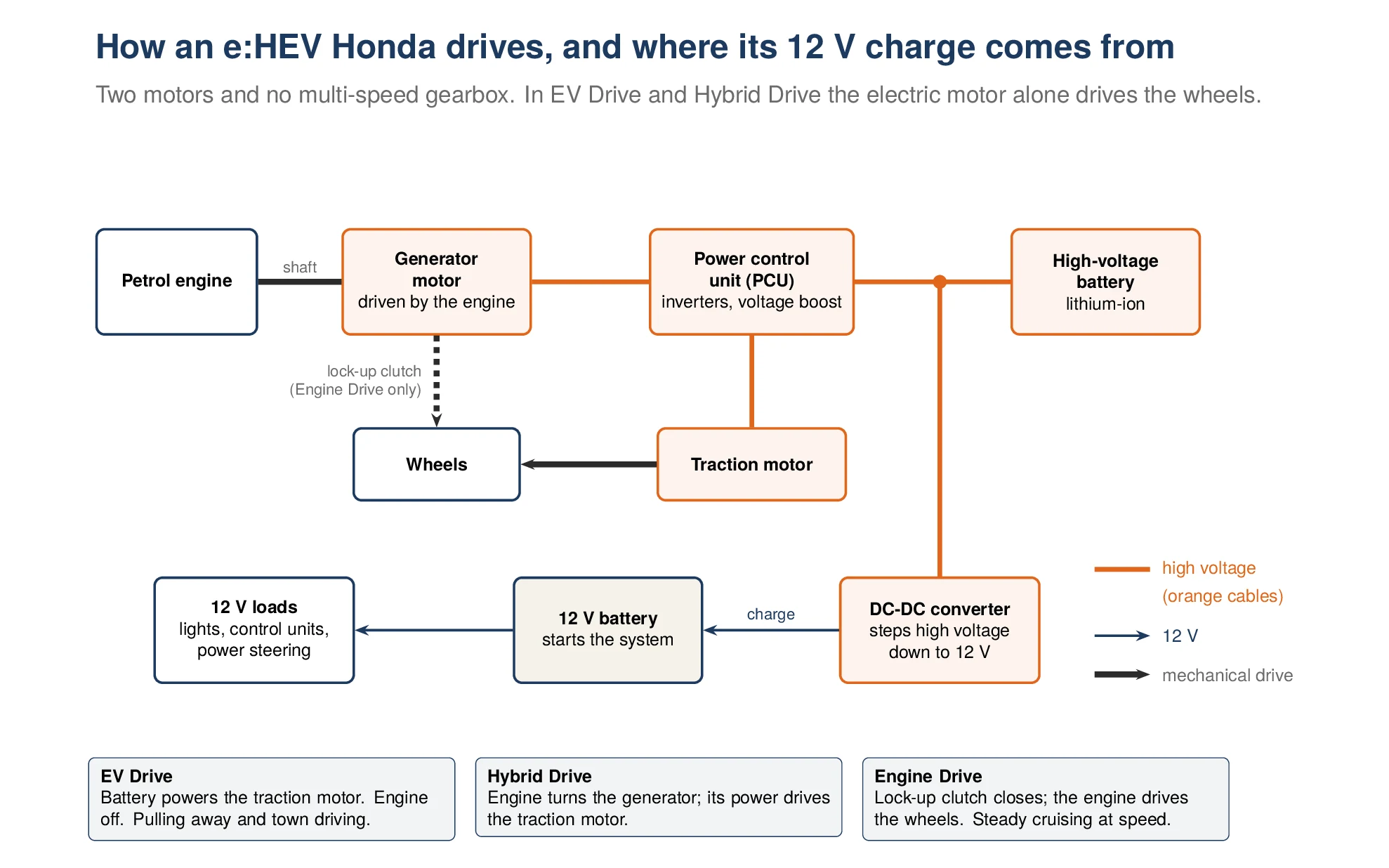
- The newer cars use the two-motor e:HEV system. These include the Fit from 2020, the Vezel from 2021 and the Freed from 2024.
How the system works
- One motor, inside the gearbox. A 1.5 L petrol engine drives a seven-speed dual-clutch transmission (DCT) with the electric motor built into it. In the Fit Hybrid the motor is rated at 22 kW.
- Four ways of driving. Honda's owner's manual for the Fit Hybrid lists four:
- EV drive runs on the motor alone, when pulling away and when cruising at low and medium speeds.
- Hybrid drive uses the engine and motor together, under firm acceleration.
- Engine drive runs on the engine alone, under gentle acceleration and at speed. The motor may also act as a generator and charge the high-voltage battery.
- Regeneration uses the motor as a generator when slowing down.
- The IPU (intelligent power unit) combines the lithium-ion high-voltage battery with the power drive unit, the inverter that runs the motor. In the Fit Hybrid it sits at the rear of the car.
- Two batteries. In Honda's own words, the 12 V battery runs the airbags, lights and accessories. The high-voltage battery drives the motor and charges the 12 V battery. A DC-DC converter steps the high voltage down to 12 V to do this.
- The 12 V battery starts the car. The manual also notes that starting the power system uses the 12 V battery. If the 12 V battery is flat, the car will not start, however full the high-voltage battery is.
Safety first
- Do not open the IPU or touch the orange cables. They carry high-voltage DC. Honda's manual warns that taking the high-voltage system apart can cause electric shock. Work on that side belongs to a trained technician with the right tools.
- Check accident-repaired imports. These cars have a high-voltage cut-off that can switch the system off after an impact. Once it has tripped, the car will not drive, and Honda's manual says a Honda dealer must restart the system.
- Everything in the checks below is on the 12 V side, which is as safe to work on as any car battery.
The warning lights that matter
Honda's owner's manual for the Fit Hybrid describes these:
- The 12 V battery charging warning light means the 12 V battery is not being charged. Honda's instruction has three parts:
- Switch off the air conditioning, the rear demister and other loads.
- Take the car to a workshop at once.
- Do not switch the car off at a short stop. The power system needs the 12 V battery to start, so it may not start again.
- The power system warning light means a fault in the hybrid system. If it comes on while driving, have the car checked straight away.
- The shift position lights also act as the transmission warning.
- All of them on together for a few seconds: the gearbox is adjusting itself. The car will not accelerate during that time, and if the lights go out, all is well.
- The selected position flashing: the gearbox has a fault. Avoid hard acceleration and have it checked. If the lights flash and the car will not move, stop somewhere safe.
- A low-battery message in slow traffic. Long stretches of slow driving can run the high-voltage battery down. Speeding up, or stopping with the brake on, slows the drain. If it falls further, the manual says to stop somewhere safe, select P and let the car idle until the high-voltage battery recharges. Lusaka's rush-hour traffic is exactly the kind of driving that causes this.
Keep the battery's air intake clear
The high-voltage battery is cooled with air from inside the car. In the Fit Hybrid the intake is a grille beside the rear seat. Honda warns that if the grille is blocked, the battery heats up. The car then limits its power to protect the battery, and both the power system and 12 V charging warning lights can come on.
Keep bags, seat covers and dust away from the grille. On other models the intake is in a different place, so check the owner's manual.
What to check, in order
- Read the fault codes first.
- Use Honda's scan tool or a scanner that covers Honda's hybrid and transmission systems. A basic OBD2 reader may show nothing even when the hybrid system has stored codes.
- Record every code before disconnecting anything.
- Disconnecting or replacing the 12 V battery can make the high-voltage battery gauge drop. Honda says it recovers as you drive, so do not mistake it for a new fault.
- Check the 12 V battery.
- After a few hours parked, a full, healthy battery reads about 12.6 V. Below about 12.2 V it is half charged or less.
- Have it load-tested, whatever its age.
- The battery maker GS Yuasa points out that a hybrid's 12 V battery gives none of the usual warnings, such as slow cranking or dim headlights. It can seem fine one day and leave you stranded the next. GS Yuasa puts the life of these batteries at three to five years.
- Check the connections. Clean and tighten the terminals and check the main fuses. Check the battery's earth cable to the body and the earth straps to the engine and gearbox.
- Check whether it is charging.
- Switch the car on until it shows READY, and measure across the 12 V battery. The engine may stay off, which is normal.
- When the battery is being charged, the reading rises clearly above its resting voltage. If it stays at or below the resting voltage, nothing is charging it.
- The battery gauge on the dashboard shows the high-voltage battery, not the 12 V battery, so only the meter answers this.
- Jump-start the car if it is flat. Honda's procedure for the Fit Hybrid is:
- Switch both cars off.
- Connect the positive terminals of the two 12 V batteries.
- Connect the donor car's negative terminal to the earth stud on your car's engine, not to your battery's negative terminal.
- Start the donor engine and hold it at slightly raised revs, then start your car.
- Once your car is READY, let it idle until the 12 V battery recovers.
If the 12 V battery and its wiring are sound and the car still does not charge it, the fault is on the high-voltage side. That calls for a technician with a Honda-capable scan tool, working to the codes from step 1.
Known problems: the 2013–2014 recalls
The first i-DCD cars had a difficult start. In Japan, Honda recalled early Fit Hybrids and Vezel Hybrids several times:
- October 2013: 4,883 Fit Hybrids, for faulty DCT control software.
- December 2013: 36,100 Fit Hybrids in a service campaign for the same software. Separate recalls covered the programs in the engine control unit, the transmission driver unit and the clutch actuator.
- February 2014: 81,353 Fit Hybrids and Vezel Hybrids built from July 2013 to February 2014. The car might be slow to move off or not move at all, roll back on a slope, or fail to accelerate. Where a gearbox's shift history showed failed gear changes, Honda replaced DCT parts before loading new software.
- July 2014: more than 175,000 Fit and Vezel hybrids, for engine control software that could cause unintended acceleration.
Honda's February 2014 recall notice lists the symptoms of the faults it fixed:
- a flashing transmission warning, with the car stuck in N or P;
- a car running on only the odd or only the even gears;
- a "system check" message, with the car running on the engine alone;
- the engine warning light and poor acceleration after a long downhill run.
If you see these on a car built in that period, first find out whether the recall work was done. According to the same notice, Honda marked repaired cars with yellow paint on the lower bolt head of the driver's door upper hinge. On a Japanese car, that is the right-hand door. Honda Japan's recall pages list the chassis number ranges each recall covers.
When it turns out to be the hybrid side
Once the 12 V side is ruled out, the codes point to the culprit: the high-voltage battery, the power drive unit, the DC-DC conversion, the motor or the control modules.
The i-DCD battery is lithium-ion, unlike the nickel-metal hydride packs in most IMA cars. Grid charging, used to recondition worn IMA packs, does not apply to it. Diagnosing and repairing it is high-voltage work for a trained technician.
We diagnose and repair the electronics behind hybrid and EV charging faults in Lusaka, including DC-DC converters and high-voltage batteries. For the other Honda systems, read our articles on IMA and e:HEV hybrids. You can also see our EV and battery service, read why battery electronics often fail before the cells, or contact us.