Electrifying the State Fleet: Is Zambia Ready for EV-Only Government Procurement?
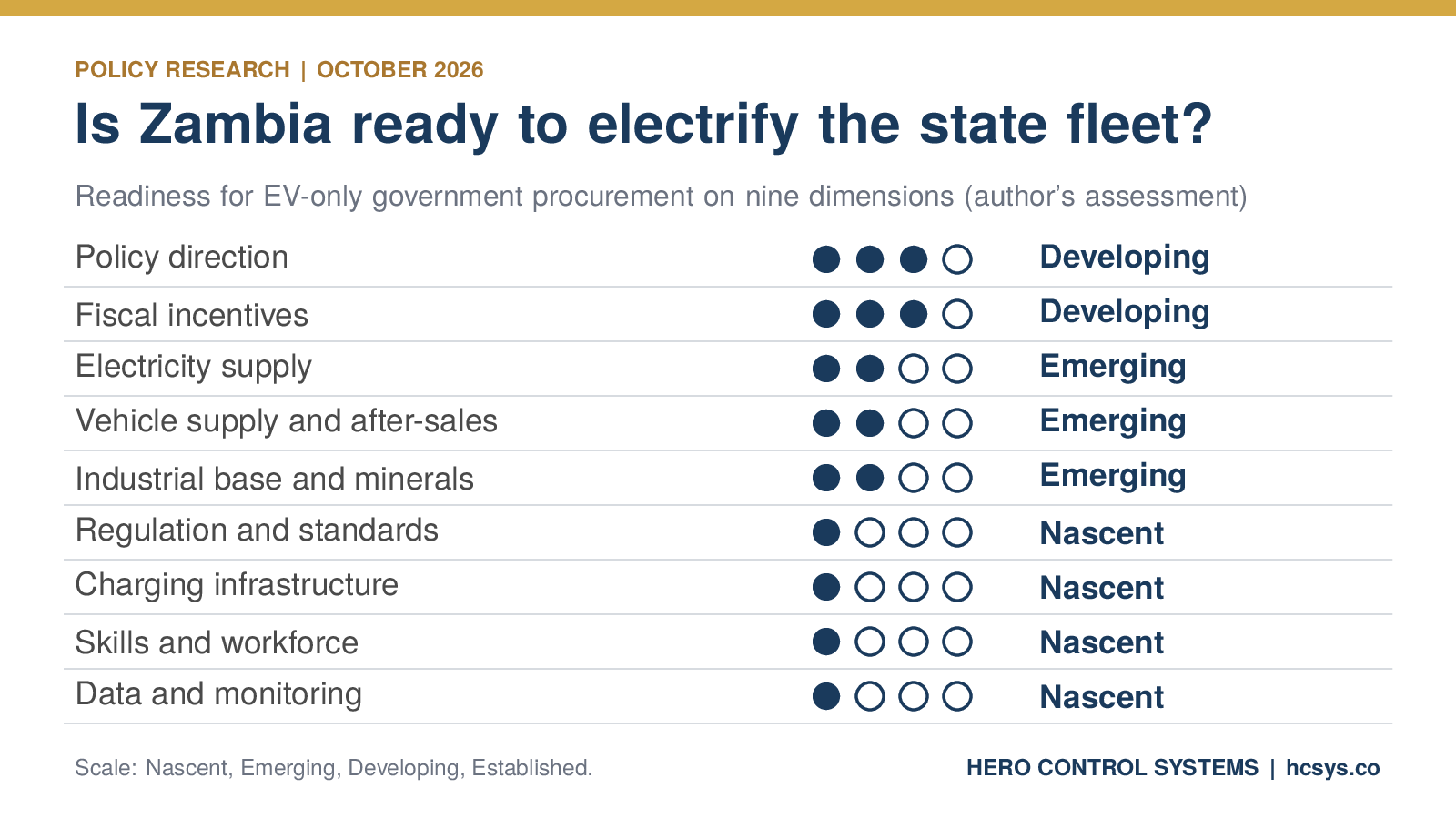
On 9 October 2026, opening the First Session of the Fourteenth National Assembly, President Hakainde Hichilema announced that all Government institutions will now acquire only electric vehicles. This paper asks whether Zambia is ready to implement that directive, what constrains it, and where it creates opportunity for Zambian enterprise and workers. It draws on official energy data, regulatory decisions, budget measures, development-partner records and press reporting checked across outlets. It rates readiness on nine dimensions and models the energy economics under stated assumptions that any ministry can replace with its own.
The short answer: the economics are compelling and the political commitment is real. Standards, charging, after-sales capacity, data and, above all, trained people are not yet in place. Whether this becomes an industry for Zambia or an import bill depends on how the first tenders are written.
Download the full paper (PDF, 27 pages, with all tables and references)
Key findings
- Intent is strong; codification is weak. Government said it would begin buying EVs in 2023, directed ministries to buy electric and hybrid vehicles in 2025, and in October 2026 moved to EV-only. No standalone e-mobility policy, procurement guideline or charging standard has been published.
- The energy saving is large. Petrol rose about 31 percent and diesel about 28 percent between September and November 2026. At those prices an electric car's energy costs roughly K37 to K54 per 100 km, against K231 for a petrol car.
- Energy volume is not the problem; reliability and location are. The 2027 power outlook makes solar-backed, managed charging at public sites essential: El Niño, and a Kariba water allocation cut from 36 to 23 billion cubic metres.
- The government fleet alone barely moves the national fuel bill. Every 1,000 vehicles electrified displace about 0.08 percent of national petrol and diesel use. The fleet's value is as anchor demand and as a demonstration for the private market.
- Skills are the binding long-run constraint, and the largest opportunity. No national EV qualification yet covers high-voltage safety, diagnostics, battery and power-electronics repair, or charger installation.
- Procurement design decides whether the value stays in Zambia. Tender clauses on local certified technicians, training, diagnostic access, parts stocks and battery take-back cost little. They decide who services the fleet for the next 15 years.
1. The directive
Within a wider energy package, the President said that "all Government institutions will now exclusively acquire electric vehicles", to counter global fuel-price volatility worsened by geopolitical tensions (Republic of Zambia press release, 9 October 2026). He said Government would partner with the private sector to establish charging infrastructure across the country, and urged businesses, cooperating partners and citizens to embrace electric mobility (Zambian Observer).
The same address restored excise duty on fuel to fund free education, the Constituency Development Fund and social cash transfers. It also accelerated pipelines to Angola, Namibia, Tanzania and Zimbabwe, called for a review of the ERB's monthly fuel-pricing mechanism, and set a 10,000 MW generation target. Press reporting indicates the transition is to be gradual, has begun at State House and Cabinet Office, and allows exceptions where an EV is not practicable (Times of Zambia).
The directive came in a month of sharp price movement. With excise relief over, the ERB raised October pump prices from K25.29 to K31.46 per litre of petrol and from K26.86 to K33.27 per litre of diesel (Lusaka Times). For November it raised them again, to K33.06 and K34.45 (News Diggers, 31 October 2026). In two months petrol rose 30.7 percent and diesel 28.3 percent.
Zambia imports all the petroleum it consumes. Imports of petroleum products rose 25.1 percent in 2024, to 2,032,382 tonnes, and diesel made up 73.8 percent of them. Electricity is generated at home, and 81.43 percent of installed capacity is hydropower (ERB, Energy Sector Report 2024). Electrifying vehicles swaps exposure to oil prices and the exchange rate for exposure to rainfall. That swap is the heart of the readiness question.
2. How the assessment was done
The paper focuses on the light-duty public fleet: the sedans, SUVs, pickups and pool vehicles of ministries, provinces and spending agencies. It rates readiness on nine dimensions using a four-point scale (Nascent, Emerging, Developing, Established). Evidence was weighted in this order: official statistics and regulatory decisions; official statements; independent research; and press reports, used only where cross-checked or clearly attributed. All sources were accessed on 31 October 2026.
The study has limits. There is no public register of government vehicles, so the size of the fleet cannot be stated. The tariffs used were approved for November 2025 to October 2026, and tariffs from November 2026 had not been published at the time of writing. The paper has not yet been externally peer reviewed, and comments and corrections are invited.
3. How policy got here, 2022 to 2026
| Date | Development |
|---|---|
| Apr 2022 | DRC–Zambia Cooperation Agreement for Manufacturing Batteries signed in Lusaka; a US–DRC–Zambia MoU on an EV battery value chain follows in December (IGF, 2026) |
| Feb 2023 | Lusaka's first public EV charger opens in Northmead (Zambia Tourism) |
| Oct 2023 | Secretary to the Cabinet says Government will begin procuring EVs before year-end (News Diggers) |
| Jan 2024 | Customs duty removed on electric cars, motorcycles, buses, trucks and charging systems; hybrid excise cut from 30 to 25 percent (RegFollower) |
| 2024 | ERB approves an EV charging pricing methodology; a code of practice is planned (ERB) |
| Dec 2024 | GEF approves "Supporting the Shift to Electric Mobility in Zambia" (UNEP, with ZEMA as executing agency): a US$2.0 million grant with US$8.57 million in co-financing (GEF) |
| Sep 2025 | Cabinet Office directs Ministries, Provinces and Spending Agencies to start procuring electric and hybrid vehicles (Lusaka Times). The 2026 Budget removes customs duty on CKD kits for vehicle assembly, including EVs (Bowmans) |
| Dec 2025 | Lusaka meeting with Uganda's Kiira Motors on a phased path from import and skills transfer to local production (MTN) |
| Jan 2026 | EU-funded EcoCharge programme begins training TEVET lecturers in Zambia and Malawi in EV and e-motorbike skills (Zambia Daily Mail) |
| Feb 2026 | Government launches a 150-unit electric-motorbike delivery pilot (Lusaka Times) |
| Mar 2026 | UNDP US$150,000 project on e-mobility policy, investment readiness and demonstration (Zambia Monitor) |
| May 2026 | Nine Government institutions reported to have procured EVs (Lusaka Times) |
| Oct 2026 | Presidential directive: Government institutions to acquire only EVs |
Three features of this trajectory matter for implementation.
It is coordination-led, not law-led. At the UNDP launch, the Secretary to the Cabinet called e-mobility a coordination challenge. He pointed to public transport fleets, delivery vehicles, motorcycles, mining mobility and corridor charging as the commercially viable segments. That framing is right. But without a published policy, guideline or standard, each spending agency must interpret the directive on its own.
Uptake has lagged intent. Three years after the 2023 announcement, about nine institutions had bought EVs. The October directive removes the option of buying conventional vehicles. It does nothing about the practical gaps that slowed voluntary uptake.
The definition has narrowed. In 2025 the instruction covered "electric and hybrid" vehicles; in 2026 it says "electric". Whether that includes plug-in hybrids, range-extended EVs or conventional hybrids needs to be settled in writing, because it decides what can be bought for rural and long-distance missions.
Zambia is not alone. Ethiopia banned imports of petrol and diesel vehicles in January 2024 (IEA). Rwanda requires at least 30 percent of new public-sector vehicles to be electric (KT Press). Kenya ordered 3,000 EVs for security and administration officials in May 2026 (The Star). For public fleets, Zambia's EV-only rule goes further than Rwanda's 30 percent minimum, which makes the quality of its implementation guidance all the more important.
4. Readiness, dimension by dimension
Electricity supply
| Indicator (ERB) | 2023 | 2024 |
|---|---|---|
| Installed capacity, all sources | 3,812 MW | 3,886 MW |
| of which hydro (grid) | 3,163 MW | 3,163 MW |
| of which solar (grid) | 123 MW | 183 MW |
| Electricity sent out | 19,373 GWh | 13,324 GWh (−31.3%) |
| National consumption | 14,642 GWh | 10,436 GWh (−28.7%) |
The 2024 drought cut generation by almost a third. The ERB reports a deficit of 1,300 MW and load-shedding of up to 20 hours a day for households between March and December 2024. Supply has since recovered. Installed solar reached 841 MW by the end of July 2026 (pv magazine), and in June 2026 ZESCO ruled out nationwide load-shedding for the year (Lusaka Times).
The risk is 2027. SARCOF-33 found drier-than-normal conditions more likely across much of southern Africa in 2026/27 (SADC). Citing strong El Niño forecasts, the Zambezi River Authority cut the 2027 water allocation for power generation at Kariba from 36 to 23 billion cubic metres. It projects usable storage falling to about nine percent by the end of 2027 (Zambia Monitor). The first wave of government EVs will arrive just as the hydro system tightens. Vehicles that can only charge from the grid at an office or a home will be stranded in an outage. Government charging should be designed from the start around daytime solar, on-site storage and charging scheduled away from the evening peak.
Fuel dependence
In 2024 Zambia used about 4.51 million litres of diesel and 1.63 million litres of petrol a day, roughly 2.2 billion litres in the year. The retail channel took 98.2 percent of petrol, and mining took 30.7 percent of diesel (ERB). The TAZAMA pipeline and new storage improve security of supply. They cannot insulate pump prices from oil markets or the Kwacha.
Fiscal incentives
Since January 2024, fully electric vehicles and charging systems have been imported free of customs duty, and since the 2026 Budget so have CKD kits for local assembly. VAT still applies. The incentives are real but narrow: they cut import costs, but do nothing for the cost of capital, charging, residual-value risk or training.
Regulation and standards
The ERB approved an EV charging pricing methodology in 2024 and plans a code of practice to ensure "compatibility, safety and interoperability". At the time of writing, the author could not find a published Zambian standard for charging equipment, a national e-mobility policy or an EV procurement guideline. Registering electric two-wheelers also ran into specifications missing from the vehicle registration system, a problem the responsible minister has acknowledged.
Charging infrastructure
In September 2025 Cabinet Office tasked the energy and transport ministries, working with private partners, with putting chargers, including fast chargers, in every district. No public registry or count of charging points exists. Interoperability is a live risk. New vehicles sold in Europe and southern Africa mostly use the Type 2 connector for AC charging and CCS2 for DC, within the IEC 61851 standards. Used Japanese imports commonly carry CHAdeMO, and Chinese domestic-spec vehicles carry GB/T. A fleet bought agency by agency could end up with three incompatible DC standards. Government should pick one and buy vehicles to match.
Vehicle supply and after-sales
The RTSA recorded 823,703 vehicles on the road at the end of 2023. Registered EVs rose from 62 in July 2023 to 269 by July 2025 (CleanTechnica, citing RTSA). New EVs are sold through a small number of franchised dealers, and used Nissan Leafs through independent importers.
The harder question is mission fit. A lot of government work means long rural trips on gravel, far from any charger, in four-wheel-drive vehicles. Electric pickups are only now arriving. Toyota's battery-electric Hilux has a 59.2 kWh battery and a development target of 300 km or more on the optimistic NEDC cycle (Toyota). Laden, air-conditioned driving on gravel will fall well short of that. For many rural missions BEVs are not yet practicable. So the exceptions mechanism, and what is bought in its place, matters as much as the rule. After-sales capacity is thin as well. Warranties tie servicing to authorised workshops, and used imports arrive with unknown battery health.
Industrial base and minerals
Zambia is Africa's second-largest copper producer, with significant cobalt, manganese and nickel reserves. Copper output reached 890,346 tonnes in 2025, against a national target of 3 million tonnes by 2031 (Ecofin). The Ndola Multi-Facility Economic Zone is Zambia's platform for the DRC–Zambia battery initiative. In its October 2026 review, the IGF found implementation "at an early stage" and named administrative fragmentation and uncertainty over incentives as Zambia's main obstacles. Mining already runs large electric systems: First Quantum's trolley-assist haulage at Kansanshi and Sentinel draws power from overhead lines and displaces diesel (Engineering News). That is a pool of high-voltage maintenance experience an EV workforce can draw on.
Finance, procurement and data
Battery prices keep falling. BloombergNEF reports average pack prices of US$108/kWh in 2025, but US$182/kWh outside China (BloombergNEF). The EV price premium falls on capital budgets, while the savings accrue to fuel budgets. Without whole-life costing, agencies will buy the cheapest compliant vehicle rather than the cheapest to own. No public register records government vehicles by type, age, mission or mileage. Without one, nobody can rank vehicles for replacement or verify the savings.
Readiness scorecard
| Dimension | Rating | Basis |
|---|---|---|
| Policy direction | Developing | Presidential directive and Cabinet Office coordination; no published policy or guideline |
| Fiscal incentives | Developing | Zero duty on EVs, chargers and CKD kits; no capital or financing support |
| Regulation and standards | Nascent | Charging-price methodology only; no charging standard or code of practice yet |
| Electricity supply | Emerging | 82% hydro; 841 MW solar; Kariba 2027 allocation cut by 36% |
| Charging infrastructure | Nascent | A handful of public chargers; no registry |
| Vehicle supply and after-sales | Emerging | 269 registered EVs; few franchised dealers; electric 4×4s only now arriving |
| Skills and workforce | Nascent | No EV-specific national qualification; lecturer training began in 2026 |
| Industrial base | Emerging | Minerals and Ndola MFEZ designated; no EV or battery plant operating |
| Data and monitoring | Nascent | No public fleet register |
Zambia is strongest where a decision can be made at the centre (policy and tax), and weakest where capability has to be built in the field (standards, charging, skills and data). The directive succeeds or fails on the second group.
5. The economics
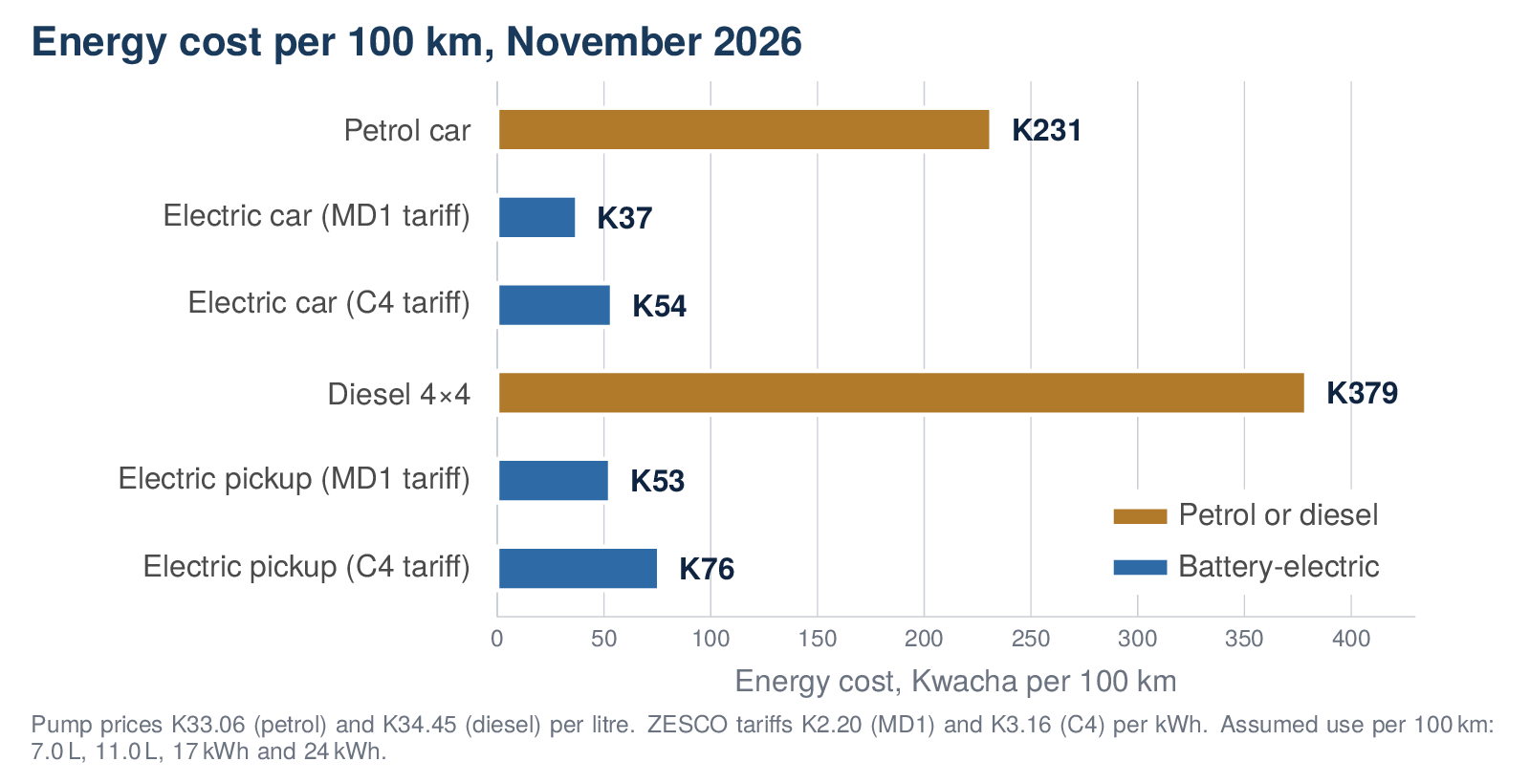
On these assumptions, an electric car's energy costs 16 to 23 percent of a petrol car's, and an electric pickup's 14 to 20 percent of a diesel 4×4's. The result holds under stress. If tariffs rose 50 percent and pump prices fell 25 percent, electricity would still cost less than half as much as fuel per kilometre.
At 20,000 km a year, an electric car saves about K35,500 to K38,800 a year in energy and an electric pickup about K60,600 to K65,200. Over five years, undiscounted, that comes to K178,000 to K194,000 for a car and K303,000 to K326,000 for a pickup: roughly the purchase-price premium that energy savings alone could repay. The figures leave out maintenance, which is usually lower for EVs. They also leave out insurance, finance, discounting, battery degradation and residual value. Tenders should therefore be evaluated on whole-life cost under published assumptions, not on purchase price.
| Government EVs | 1,000 | 5,000 | 10,000 |
|---|---|---|---|
| Electricity use (GWh a year) | 4.1 | 20.5 | 41.0 |
| Share of 2024 national consumption | 0.04% | 0.20% | 0.39% |
| Worst-case simultaneous load (MW) | 7.4 | 37 | 74 |
| Fuel displaced (million litres a year) | 1.8 | 9.0 | 18.0 |
| Share of 2024 petrol and diesel use | 0.08% | 0.40% | 0.80% |
| Net energy saving (K million a year) | 48–52 | 239–259 | 478–517 |
Two conclusions follow. First, energy volume is not the constraint. Even 10,000 government EVs would need under 0.4 percent of national consumption. Peak load and location are what matter: a worst case of 74 MW of simultaneous charging would be material in a deficit like 2024's, so charging must be managed and, where possible, solar-supplied. Second, the government fleet alone cannot fix the fuel import bill. Its strategic value is as anchor demand, a large and predictable buyer that can justify the chargers, dealers, service centres and training the private market will then use.
There is also a fiscal tension. The same address restored fuel excise to fund social programmes. At public-fleet scale the effect on revenue is small. But if electrification spreads to the private market it will erode the fuel-tax base, and long-term planning should prepare for a distance- or registration-based road-user charge.
6. Challenges
- Definitions and exceptions. Neither "electric" nor "not practicable" is defined in writing.
- Power reliability in 2027. Charging that depends only on the grid at offices is a single point of failure.
- Charging coverage and interoperability. Few public chargers, no registry, no equipment standard, and a risk of mixed CCS2, CHAdeMO and GB/T fleets.
- Mission fit. Electric options for rural and off-road work are new, and their range is limited.
- Budget structure. The premium is a capital cost while the savings land in fuel budgets, and lowest-price evaluation penalises the vehicle that is cheaper to own.
- After-sales and parts. Dealer networks are thin, and used imports arrive with unknown battery health.
- Skills and safety. Untrained work on high-voltage systems, typically 400 V-class DC, endangers technicians and first responders.
- Data. Without a fleet register, replacement cannot be prioritised and savings cannot be verified.
- End-of-life batteries. Collection, second life and recycling are not yet regulated for traction batteries.
- Fiscal base. In the long run, electrification erodes fuel excise and road-fund revenue.
7. Opportunities
The directive is a demand signal of a kind Zambian industry rarely receives: a large, long-lived public market for new technical services.
- Solar-backed charging at public facilities. Fleet vehicles are parked at offices in daylight, when solar output peaks. The installer base already exists: the ERB issued 251 renewable-energy equipment licences in 2024, up from 90 the year before.
- Charger installation, operation and maintenance. Design, installation, commissioning, metering, payment and upkeep are local by nature and cannot be imported.
- Power-electronics repair. EV inverters, on-board chargers, DC–DC converters, battery-management systems and charging stations are close relatives of the drives, UPS units, rectifiers and inverters Zambian repair firms already service for mines, utilities and telecoms. (For what fails inside EV packs, see In an EV battery, the electronics usually fail before the cells.)
- Battery services. State-of-health testing of used imports, module repair, second-life use in stationary storage and, in time, recycling. Together these link the fleet to the DRC–Zambia battery value chain.
- Local assembly. Duty-free CKD kits make assembly of two- and three-wheelers, buses and light vehicles commercially testable. A predictable government order book is the anchor demand assemblers need.
- Fleet software and data. Telematics, charging management and mobile-money payment for public charging, plus the fleet register the Treasury needs. All of it can be built and run in Zambia.
- Training as an industry. The skills market, at home and in neighbouring states facing the same transition.
8. Training and local talent
Money can buy vehicles and chargers quickly. It cannot quickly produce a technician who can safely isolate a 400 V battery, diagnose an inverter fault or commission a DC charger to standard. Without those skills, the State will own vehicles that only the importer can repair. Downtime will rise, service will be paid for in foreign exchange, and early failures will discredit the policy. With them, the government fleet becomes the training ground for a workforce the private market will soon need.
TEVET institutions already train automotive electricians. Kabwe Institute of Technology, for example, offers a Diploma in Automotive Electrical. But no EV-specific national qualification appears in public TEVETA listings. At regional level, the battery centre of excellence at the University of Lubumbashi (CAEB) has been held back by limited funding, and its contribution so far has been "more institutional than operational" (IGF, 2026).
Who needs training
| Role | Core competencies | Gap today |
|---|---|---|
| Drivers and transport officers | EV operation, range planning, charging practice | No orientation course |
| In-service mechanics | High-voltage awareness, safe isolation, routine EV maintenance, scan-tool diagnostics | Automotive programmes exist; no HV or EV module |
| HV specialists | Battery module and BMS repair, traction inverter, on-board charger, DC–DC converter | No national route; OEM training abroad only |
| Electricians and charger installers | AC and DC charger installation, earthing, protection, load management, commissioning | No EV-charging module |
| Power-electronics and embedded engineers | Repair and design of chargers, BMS and telematics; solar and storage integration | Little EV-specific content in degrees and diplomas |
| Fleet, energy and procurement officers | Whole-life costing, specifications, charging plans, data | No short course |
| First responders | EV fires and thermal runaway, rescue and extrication | Not covered |
| Recyclers and environmental officers | Battery handling, storage, transport, second life | Not covered |
A four-level Zambian EV competence framework
The paper proposes that TEVETA adopt four levels, benchmarked against the four-level IMI TechSafe standards used internationally for EV work. They would be offered as short-course awards for in-service staff and as modules within craft-certificate and diploma programmes:
- Awareness: recognise HV hazards; operate and charge an EV safely. For drivers, transport officers, first responders and workshop support staff.
- Routine maintenance: safe work on a vehicle that someone else has made safe, such as tyres, brakes, coolant, 12 V systems and charger inspection.
- HV isolation and diagnosis: isolate and prove a vehicle dead; diagnose faults; remove and refit HV components; commission chargers.
- Component repair: repair battery modules, BMS, inverters and chargers, including controlled live diagnostics.
Assessment should be practical, on real HV training rigs, and certificates should expire unless refreshed, as is standard for high-risk electrical work.
How to deliver it
- Train the trainers first, building on the EcoCharge lecturer programme.
- Equip a few regional EV skills labs rather than many weak ones, at existing TEVET institutions on the main corridors, with HV rigs, insulated tools, battery modules, AC and DC chargers and diagnostic equipment.
- Upgrade, don't duplicate: add HV and EV modules to existing automotive-electrical and electrical-engineering curricula, and fast-track experienced auto-electricians and industrial-electronics technicians through recognition of prior learning.
- Bring industry in as co-trainer: OEM dealers, mining houses with HV experience, and Zambian power-electronics repair firms.
- Link universities to the battery agenda: power electronics, battery chemistry and BMS design at UNZA and CBU, connected to CAEB.
- Fund it from the transition: a small fixed share of each vehicle and charger contract, plus development-partner programmes.
- Design for inclusion: recruit women and young people deliberately into a new trade whose norms are still being set.
Procurement as a skills lever
The cheapest and most powerful skills instrument is the tender document. Every government vehicle and charger contract should require:
- a minimum number of TEVETA-certified Level 3 technicians employed in Zambia, scaled to the number of vehicles supplied;
- training of named public-workshop or local-SME technicians to Level 2 or 3 as a contract deliverable;
- licensed access to diagnostic tools, software and service information for government workshops and approved Zambian repairers;
- in-country stocks of critical parts, with turnaround commitments;
- battery state-of-health certificates for used vehicles, and long battery warranties for new ones;
- evaluation weighting for installation and maintenance by Zambian firms;
- take-back of traction batteries at end of life.
These clauses add little to contract cost. They decide whether the next 15 years of servicing, repair and training revenue stays in Zambia. Fire services, police, RTSA inspectors and recovery operators also need Level 1 training and clear protocols before government EVs are on every highway, not after.
9. A phased roadmap
| Phase | Actions | Lead |
|---|---|---|
| 0. Set the rules (0–6 months) | Publish an implementation circular that defines eligible vehicles and a transparent exceptions test by mission. Build a fleet register. Issue an EV procurement guideline with whole-life costing and the skills clauses above. Adopt Type 2/CCS2 as the government charging standard. Fast-track the ERB code of practice and national standards. Start train-the-trainer cohorts. | Cabinet Office; Treasury; procurement authority; ERB; ZABS; TEVETA |
| 1. Prove it where it works (6–24 months) | Replace urban pool cars and light pickups first in Lusaka, the Copperbelt and along the line of rail. Install solar-backed, managed charging at headquarters and provincial offices. Open DC corridor charging with private partners. Commission the first regional skills labs and certify the first technicians. Allow hybrids or PHEVs, under the exceptions test, for long rural missions. | Spending agencies; energy ministry; ZESCO; local authorities; TEVET institutions |
| 2. Scale and localise (2–5 years) | Extend to provincial and district fleets as electric 4×4s mature. Electrify urban buses and two- and three-wheel services. Aggregate demand to support CKD assembly. Establish battery second-life and recycling capacity. Design a road-user charge. | Transport ministry; ZDA; ZEMA; Treasury |
Progress should be reported publicly at least once a year: the share of new government vehicles that are battery-electric, and the exceptions granted; fuel litres avoided and net savings; the share of charging energy from on-site solar; vehicle availability and repair turnaround; the share of repairs done in Zambia; certified EV technicians by level, province and gender; public chargers in service by district; and traction batteries collected.
Conclusion
The directive rests on sound economics. Every litre of fuel is imported and priced in dollars, and pump prices rose by nearly a third in two months, so the energy to run an EV in Zambia costs a fraction of the fuel it replaces. The political commitment and fiscal incentives are in place. What is missing is capability in the field: standards, charging, after-sales, data and, above all, people.
The government fleet will not transform the national fuel balance on its own. Its real power is as a predictable anchor customer. It can call into being the chargers, service centres, assembly lines and trained workforce the rest of the economy will need. Implemented through lowest-price tenders, the directive will import vehicles and export the service revenue. Implemented through whole-life costing, interoperable standards, solar-backed charging and clauses that require Zambian certified technicians, it will build an industry. The second path costs little more. The window to choose it is the next six months, before the first large orders are placed.
Competing interests. The author founded Hero Control Systems Ltd., a Zambian company that provides industrial electronics repair, power-electronics design and technical training, including EV and lithium battery service. The company could benefit from the markets this paper discusses. The evidence base is public and cited throughout. No external funding was received.
Review and correspondence. This is a working paper and has not been externally peer reviewed. Comments and corrections are welcome at cephas@hcsys.co. Full tables, calculation notes and the complete reference list are in the PDF edition.
Suggested citation: Kalembo, C. (2026). Electrifying the state fleet: Zambia's readiness, challenges and opportunities for public-sector electric-vehicle procurement. Hero Control Systems Ltd., Lusaka.