Honda e:HEV hybrid: how it works, and the 12 V battery
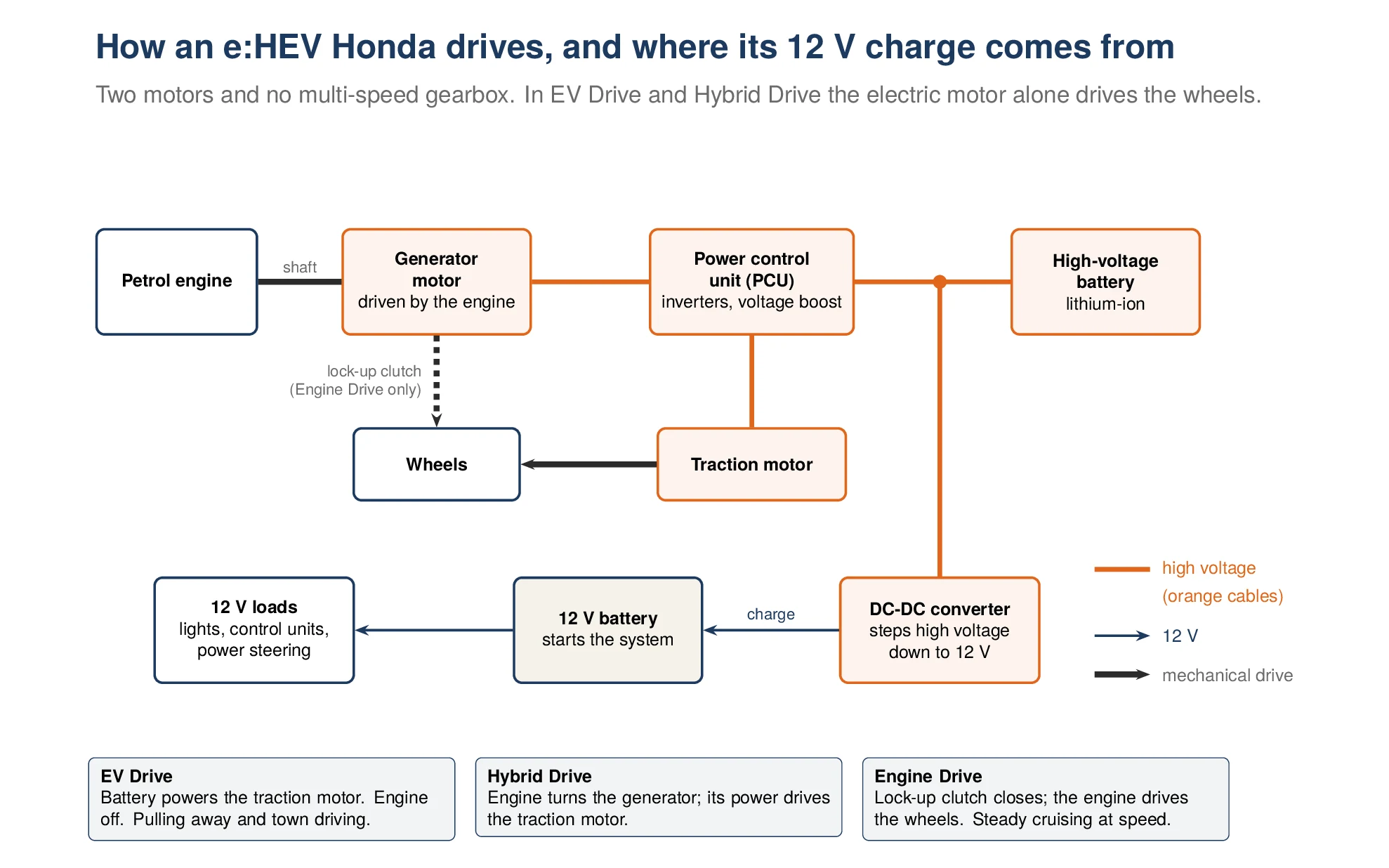
e:HEV is Honda's two-motor hybrid, and it works very differently from the older IMA and i-DCD cars. It has no multi-speed gearbox. In two of its three driving modes, the petrol engine does not turn the wheels at all. It runs a generator, and an electric motor drives the car.
One thing has not changed. The 12 V battery is still charged from the high-voltage side, through a DC-DC converter. If that charging stops, the 12 V battery runs down, and Honda's own recall filings say the car can then lose drive.
This article explains how e:HEV works, which Hondas have it, and what owners and mechanics in Zambia should check.
Which Hondas use it
The system first appeared as SPORT HYBRID i-MMD, and Honda presents e:HEV as its evolution, under the new name from 2020.
As i-MMD, it was used in:
- the Accord Hybrid, on sale in Japan from June 2013;
- the Odyssey Hybrid;
- the third-generation Insight, from December 2018;
- the CR-V Hybrid, from November 2018 in Japan.
As e:HEV, it is used in:
- the fourth-generation Fit, from February 2020. Hybrid chassis numbers start GR3, GR4, GR6 or GR8.
- the second-generation Vezel, from April 2021. Hybrid chassis numbers start RV5 or RV6.
- the third-generation Freed, from June 2024.
- models sold in Europe, including the Jazz, HR-V, Civic and CR-V e:HEV.
On a Japanese export certificate, the hybrid model codes carry the prefix 6AA-, as in 6AA-GR3 or 6AA-RV5. The petrol versions of the same cars carry 5BA- or 6BA-.
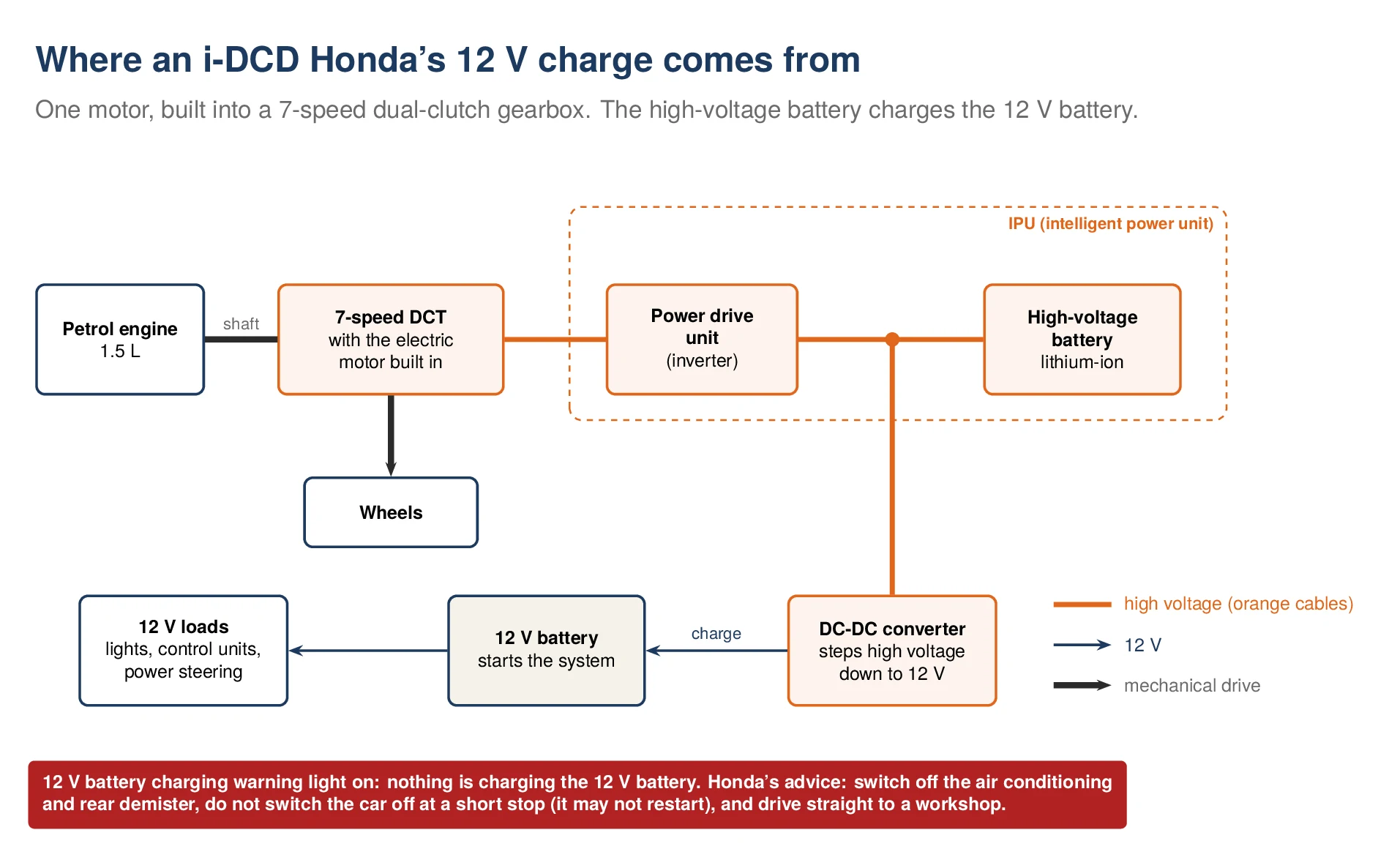
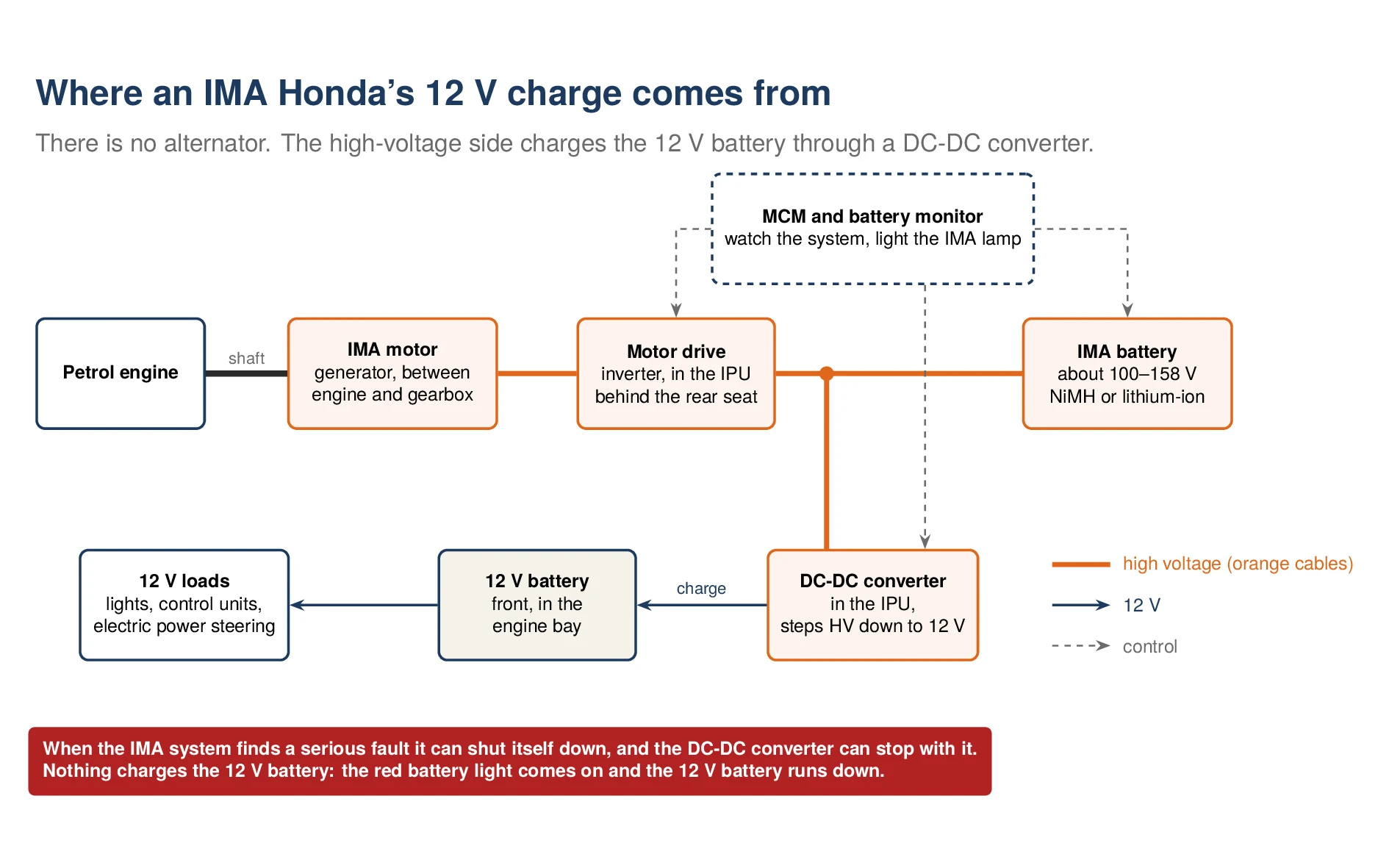
The earlier small hybrids are different systems. The Fit Hybrid from 2013 to 2020, the first Vezel Hybrid, the Grace, the Shuttle and the 2016–2024 Freed Hybrid use i-DCD. Older Hondas use IMA.
How it drives
Honda describes the system's main parts this way:
- A traction motor drives the wheels, and recovers energy when you slow down.
- A generator motor is linked to the petrol engine.
- A power control unit (PCU) converts the battery's DC into AC for the motors. It also raises the voltage: Honda quotes up to 650 V.
- A lithium-ion battery pack has its own control unit.
- A lock-up clutch connects the engine directly to the wheels.
The car switches between three modes on its own:
- EV Drive. The engine is off and the battery powers the traction motor. Honda uses this mode for pulling away and in town.
- Hybrid Drive. The engine turns the generator, and that electricity drives the traction motor. Under strong acceleration the battery adds power too. The wheels are still driven only by the motor.
- Engine Drive. At steady speed on the open road, the lock-up clutch closes and the engine drives the wheels directly. At those speeds this is more efficient than running the motor.
When you slow down or go downhill, the traction motor works as a generator and recharges the battery.
There is no multi-speed gearbox. Honda says the design does without the complicated mechanisms otherwise needed to mix engine and battery power, and without a conventional transmission. In Engine Drive, the gear ratio is about the same as top gear in a manual gearbox.
Two practical points follow:
- Engine speed does not follow road speed. In Hybrid Drive the engine may rev while the car moves slowly. In EV Drive it stops while the car keeps moving. Both are normal.
- There is no dual-clutch gearbox. The gear-change faults of the early i-DCD cars do not apply.
Where the 12 V charge comes from
An e:HEV Honda keeps its 12 V battery charged through a DC-DC converter, which steps the high voltage down to 12 V. In the 2020 Accord, CR-V Hybrid and Insight, Honda's recall filings show this converter as part of the PCU.
The 12 V battery matters more than its size suggests. It runs the lights and control units, and it is needed to start the hybrid system. Honda's US recall report states the risk plainly: if you keep driving after the 12 V charging warning comes on, the 12 V battery runs flat, and that "can restrict or eliminate motive power". In other words, the car can stop.
What a DC-DC fault looks like: two recalls
Two of Honda's recalls show this failure clearly.
- United States, December 2020 (NHTSA 20V-798).
- Cars covered: the 2020 CR-V Hybrid, the 2020 Accord Hybrid and the 2020–2021 Insight, 27,838 vehicles in all. Honda estimated that about 2% had the defect.
- The fault: some DC-DC converters had transistors with too much dopant. In cold weather, the converter's output voltage could rise until it shut itself down for overvoltage, and the 12 V battery then stopped charging.
- History: Honda had 53 warranty claims and 65 field reports, and no crashes.
- Fix: a PCU software update.
- Japan, December 2020.
- Cars covered: 2,703 Accords with model code 6AA-CV3, built from 18 December 2019 to 23 September 2020.
- The fault: after a cold start, the DC-DC converter could switch to a fail-safe mode and stop charging the battery. Warning lights and messages would follow, and the car could become undriveable.
- Fix: Honda reprograms the power-supply control in the PCU, free of charge.
Both recalls follow the same sequence: the converter stops, the charging warning comes on, the 12 V battery runs down, and the car can lose drive. That is why the charging light deserves to be taken seriously.
When buying an import, check its chassis number against Honda Japan's recall pages, which list the ranges each recall covers.
Safety first
- Do not open the PCU or the battery pack, or touch the orange cables. The PCU raises the battery voltage for the motors, to as much as 650 V by Honda's figures. That is lethal. Work on the high-voltage side belongs to a trained technician with the right tools.
- Do not drive far with the 12 V charging warning on. Switch off the air conditioning and other loads, and drive straight to a workshop.
- The checks below are all on the 12 V side, which is as safe to work on as any car battery.
What to check, in order
- Read the fault codes first, before disconnecting anything. Use Honda's scan tool or a scanner that covers Honda's hybrid systems. A basic OBD2 reader may miss them.
- Check the 12 V battery. After a few hours parked, a full, healthy battery reads about 12.6 V. Below about 12.2 V it is half charged or less. Have it load-tested, whatever its age.
- Check the connections. Clean and tighten the terminals and check the main fuses and the earth cables.
- Check whether it is charging.
- Switch the car on until it shows READY, and measure across the 12 V battery. The engine may well stay off.
- When the battery is being charged, the reading rises clearly above its resting voltage. If it stays at or below the resting voltage, nothing is charging it.
- The battery gauge on the dashboard shows the high-voltage battery, not the 12 V battery.
- Check for recalls on that chassis number, especially for an Accord built in 2019 or 2020.
- If the battery and wiring are good but nothing charges it, the DC-DC converter or the PCU is the next suspect. That needs a technician with a Honda-capable scan tool, working to the codes from step 1.
To jump-start a flat car, follow the owner's manual for your model. It shows where to connect the leads.
Looking after the 12 V battery
- It fails without warning. The battery maker GS Yuasa points out that a hybrid's 12 V battery gives none of the usual warning signs, such as slow cranking or dim headlights, because it starts the hybrid system rather than turning the engine over. It can seem fine one day and leave you stranded the next. GS Yuasa puts its life at three to five years.
- It needs regular driving. The same maker advises driving for at least an hour every one to two weeks to keep the battery charged.
- A car that has stood for weeks at a yard, in transit or in a garage may have a flat or damaged 12 V battery. Test it before blaming the hybrid system.
- Heat is hard on lead-acid batteries, and Zambia's hot season shortens their life. Test the battery at every service.
- Keep the cooling intake clear. If your model draws cabin air to cool the high-voltage battery, the owner's manual shows where the intake is. Keep it clear. On the i-DCD Fit Hybrid, Honda warns that a blocked intake makes the car limit its power.
We diagnose and repair the electronics behind hybrid and EV charging faults in Lusaka, including DC-DC converters and high-voltage batteries. For the earlier Honda systems, read our articles on i-DCD and IMA hybrids. You can also see our EV and battery service, read why battery electronics often fail before the cells, or contact us.