Honda hybrid IMA fault: why the 12 V battery stops charging
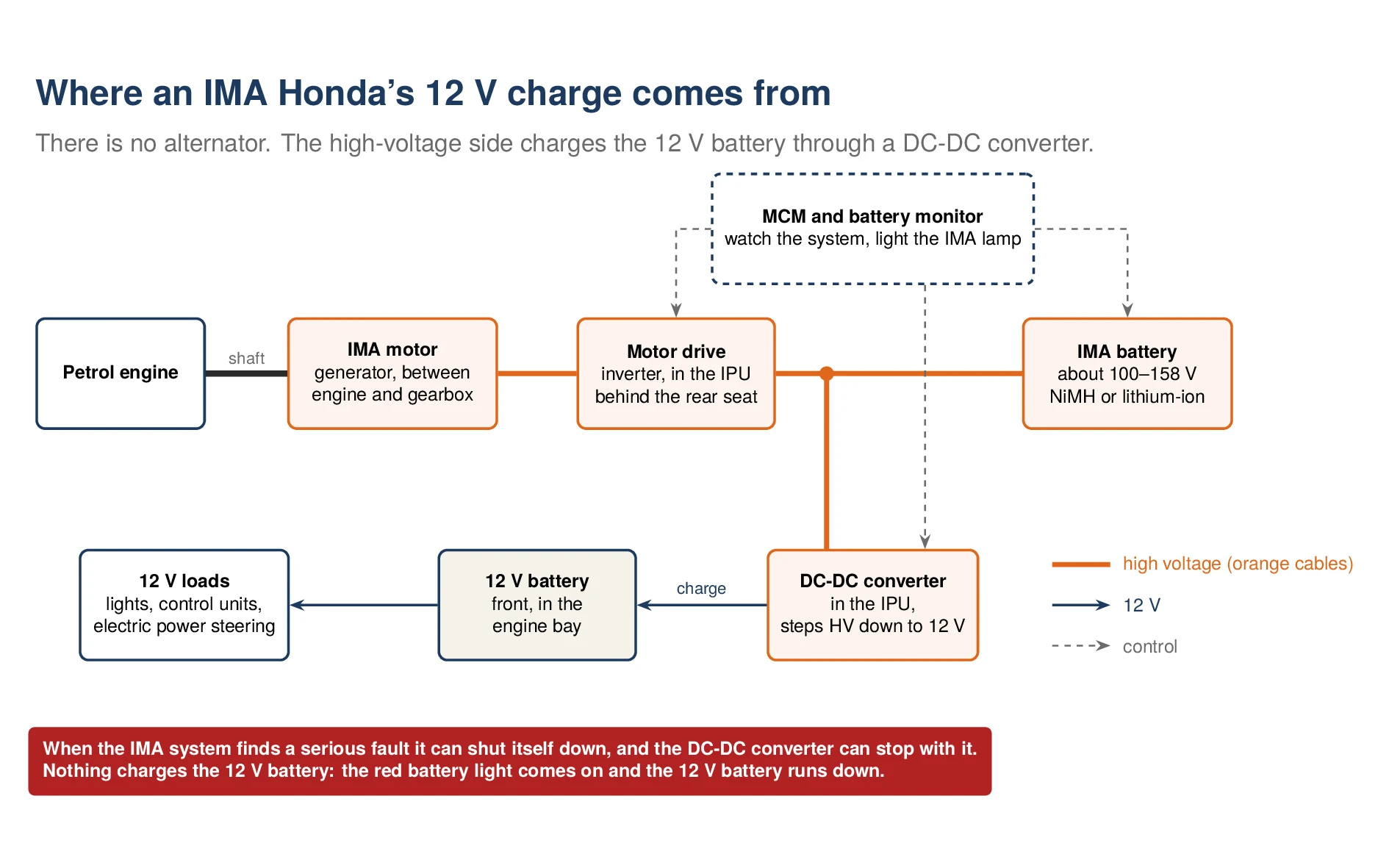
A Honda IMA hybrid has no alternator. Its front 12 V battery is charged by the hybrid system itself, through a DC-DC converter that takes power from the high-voltage side. When the IMA system finds a serious fault, it can shut itself down and stop that converter with it. Nothing then charges the 12 V battery. The red battery light comes on, and the car runs on whatever is left in the 12 V battery.
This article explains how the charging works, what to check and in what order, and what the fault usually turns out to be. Many of these cars reach Zambia as used imports from Japan, so the warning on the dash is often in Japanese, as in the video below.
Which Hondas this applies to
IMA (Integrated Motor Assist) is Honda's earlier hybrid system: a thin electric motor between the engine and the gearbox, and a high-voltage battery behind the rear seat. It is used in:
- the Insight, both the first model (1999–2006) and the second (2009–2014);
- the Civic Hybrid (2003–2015) and the Accord Hybrid (2005–2007);
- the CR-Z (2010–2016);
- the first Fit (Jazz) Hybrid (2010–2013), and the Fit Shuttle Hybrid and Freed Hybrid of that generation.
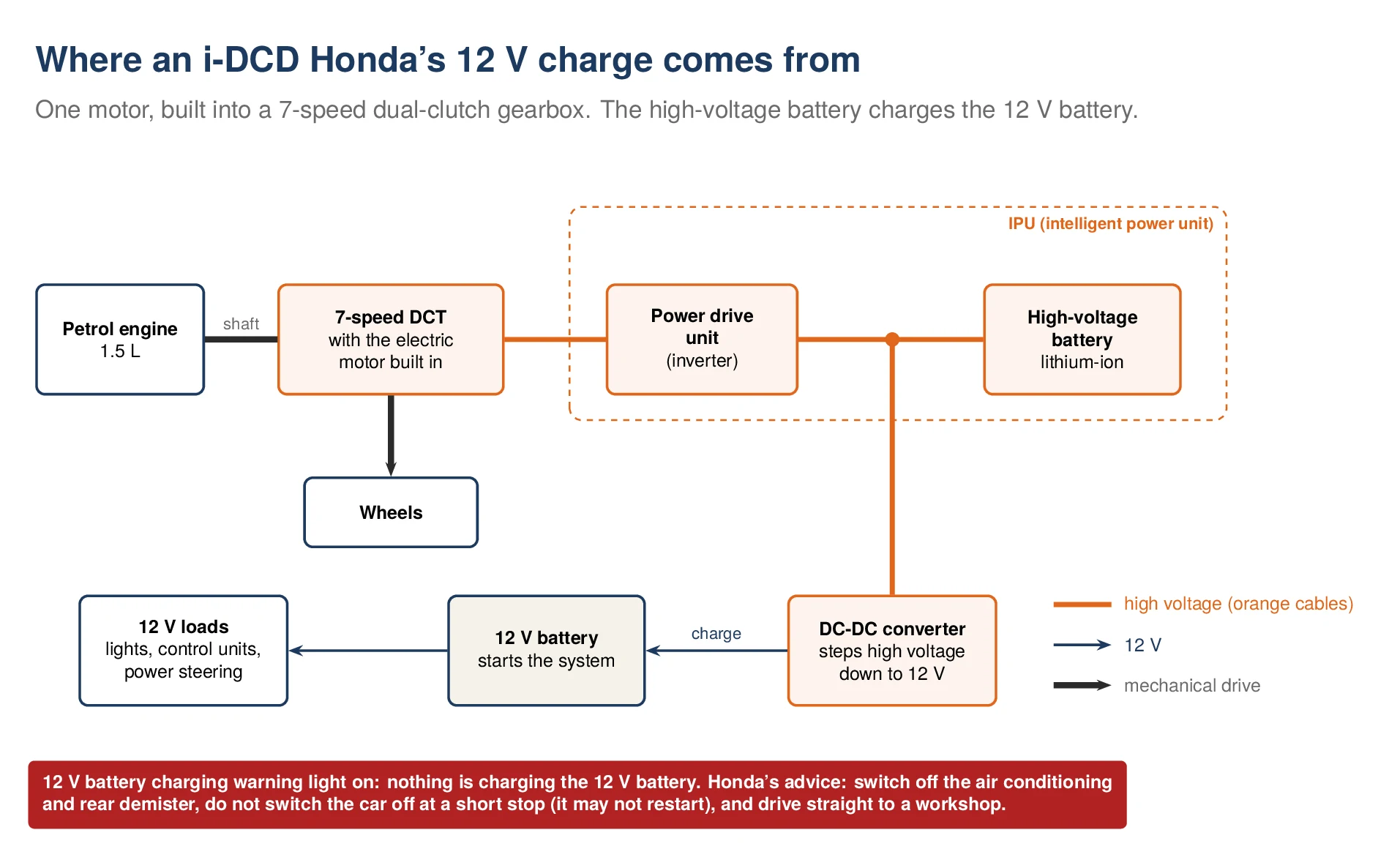
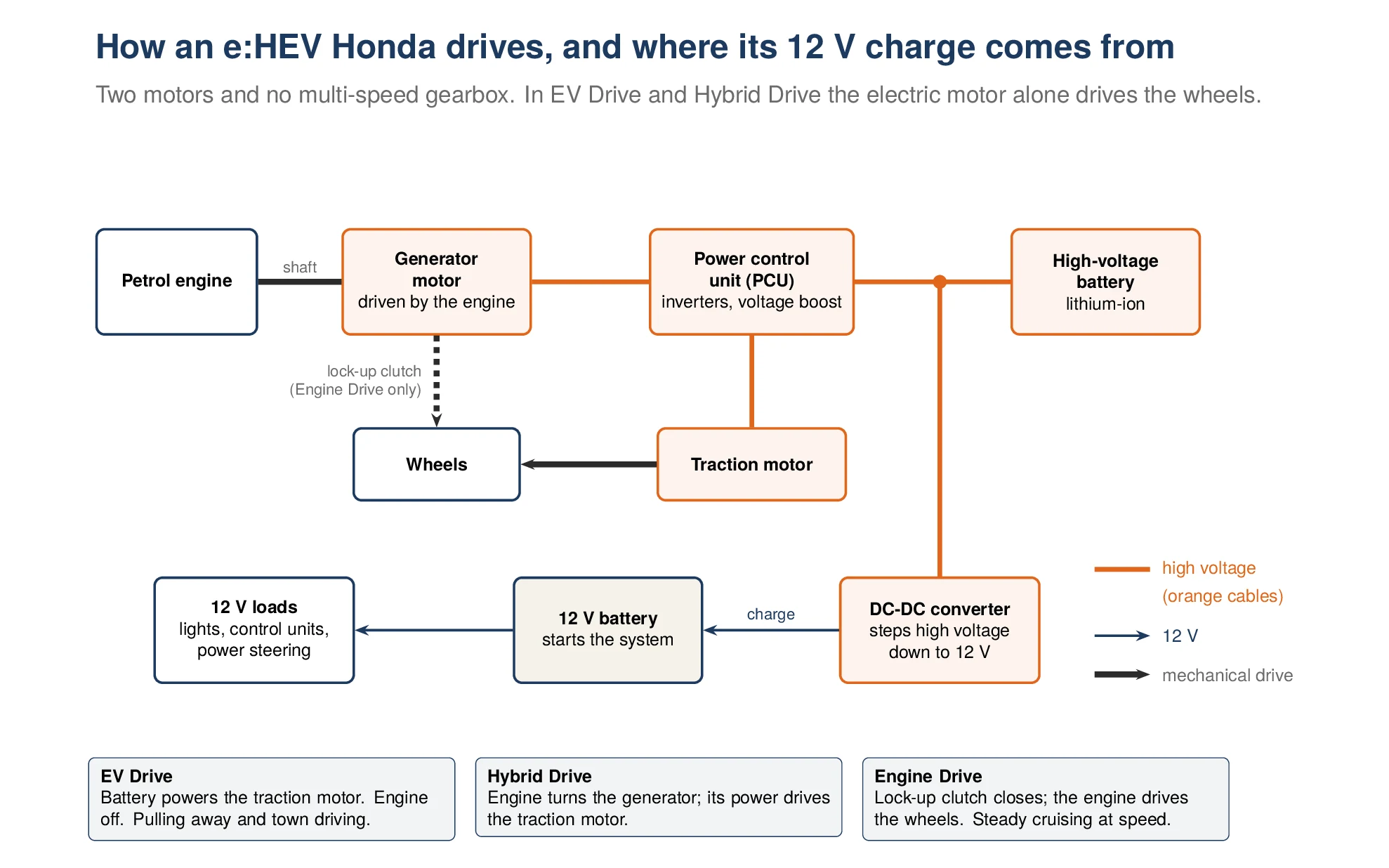
Later Honda hybrids work differently. The Fit Hybrid from late 2013, the Vezel Hybrid, the Grace and the Shuttle use the i-DCD system, and today's models use e:HEV. The steps below are for IMA cars only.
How the 12 V battery is charged
- The IMA battery is a high-voltage pack, about 100–158 V depending on the model, nickel-metal hydride in most cars and lithium-ion in some later models. It sits in the Intelligent Power Unit (IPU) behind the rear seat.
- The IMA motor helps the engine when you accelerate and works as a generator when you slow down, charging the IMA battery through the motor drive (inverter) in the IPU.
- The DC-DC converter, also in the IPU, steps the high voltage down to charge the 12 V battery and run the car's 12 V loads. It does the job an alternator does in other cars.
- The motor control module (MCM) and the battery monitor watch the whole system. When they find a fault, they light the IMA lamp, store a fault code and, for serious faults, shut the system down.
That is why an IMA fault so often brings the red battery light with it: when the IMA system stops, the converter that charges the 12 V battery can stop too.
Safety first
- Do not open the IPU or touch the orange cables. They carry the high-voltage DC from the IMA battery, enough to kill. Work on the IMA battery, motor drive and DC-DC converter belongs to a trained technician with the right tools.
- Everything in this article is on the 12 V side, which is as safe to work on as any car battery.
- Do not drive far with the red battery light on. The 12 V battery is running down. When it is flat, the engine control and the electric power steering lose power, and the car can stall. Drive only as far as you must to reach a workshop.
Step 1: Read the fault codes before anything else
The reset in step 4 clears the modules' memory, and with it the fault codes that say why the IMA system tripped. Read them first.
- The diagnostic port is under the dashboard on the driver's side.
- Many generic OBD2 readers only see the engine control unit. IMA codes are stored in the MCM and the battery monitor, so you may need Honda's own scan tool or a scanner that covers Honda hybrid systems. If a basic reader shows no codes, that does not mean there are none.
- Photograph or write down every code, with the car's mileage and the date.
Codes such as P0A7F, "hybrid battery pack deterioration", point straight at the IMA battery.
Step 2: Check the 12 V battery and its connections
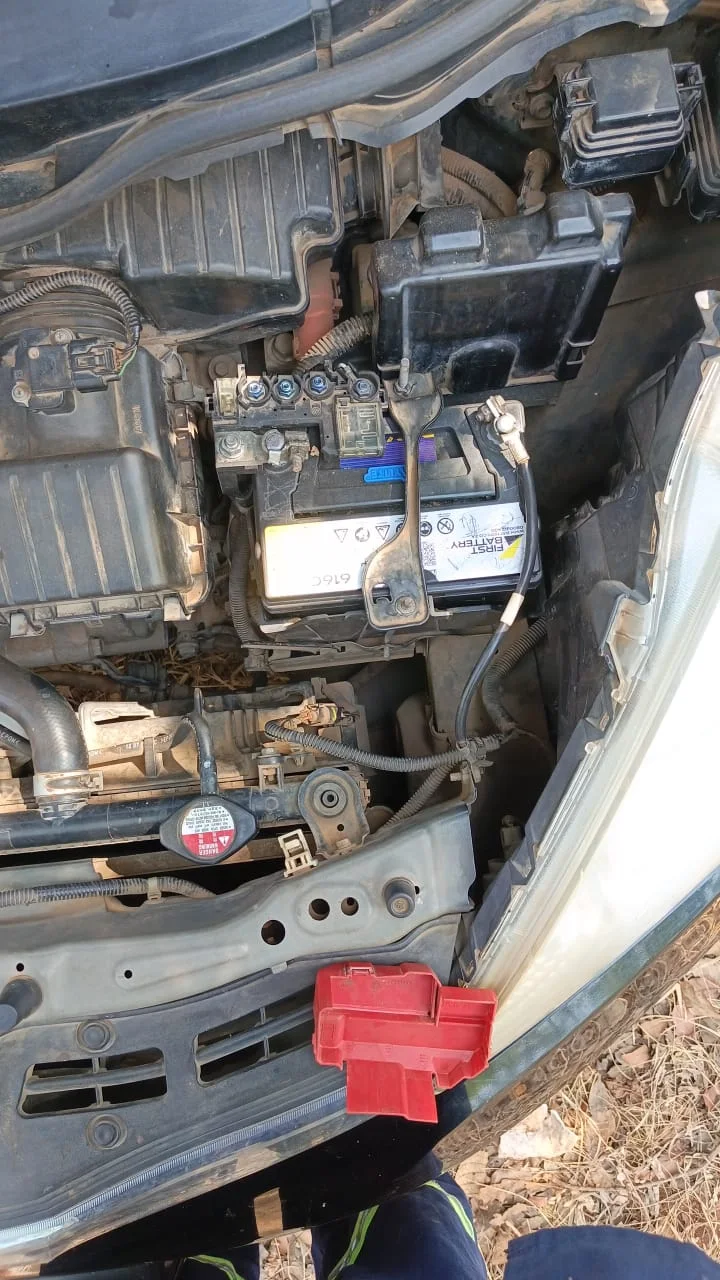
A weak 12 V battery or a poor connection can cause IMA faults of its own, because the control modules misbehave on low voltage. Rule them out before blaming the hybrid system.
- Measure the resting voltage. With the car off for a few hours, a healthy, full battery reads about 12.6 V. Below about 12.2 V it is half charged or less.
- Have it load-tested, whatever its age. A battery can show 12.6 V and still collapse under load. Heat shortens the life of lead-acid batteries, and Zambia's hot season is hard on them.
- Clean and tighten the terminals, and check the main fuses on the positive terminal.
- Check the earth cables. Look at the battery's negative cable to the body and the earth straps to the engine and gearbox. These cables can corrode inside while looking fine outside. With the engine running, measure between the battery's negative post and the engine block: more than a few tenths of a volt means a bad earth.
Step 3: Check whether it is charging
With the engine running, measure across the 12 V battery's terminals. A charging system typically holds about 13.5–14.5 V. If the reading is at or below the battery's resting voltage, nothing is charging it, whatever the gauges say.
Do not use the charge gauge for this. The battery gauge on an IMA Honda's dash shows the state of charge of the high-voltage IMA battery, not the 12 V battery. Only a meter on the 12 V battery tells you whether that battery is being charged.
Step 4: The 12 V reset (a temporary fix)
Once the codes are recorded, disconnecting the 12 V battery clears the IMA modules' memory. This often lets the system restart and resume charging for a while.
- Switch the car off and remove the key.
- Disconnect the negative cable from the 12 V battery, with a 10 mm spanner on most models, and leave it off for at least 30 seconds.
- Reconnect it, start the car and let it idle. If your radio or navigation asks for a code afterwards, you will need it, so find it before you start.
- Check the charging voltage again, as in step 3.
After a reset, many IMA cars recharge their high-voltage battery as they drive, and you will see the charge gauge climb. That is the IMA battery recovering. The 12 V battery is charging only if the meter says so.
Step 5: Check charging above idle
If the 12 V battery still does not charge at idle, put the car in Park with the handbrake on. Hold the engine between about 1,500 and 3,500 rpm for 30 seconds while someone watches the battery light and the meter.
If the light goes out and the voltage rises only while the engine is above idle, the 12 V battery is charging, but only in a limited way. That is a symptom of the IMA fault, not a cure. Use it to get the car safely to a workshop, not to keep driving it.
What it usually turns out to be
If the reset works only for a while and the IMA light keeps coming back, the fault is still there. The usual causes are:
- A worn IMA battery. After years of heat and cycling, the cells of a nickel-metal hydride pack lose capacity and drift out of balance, and the battery monitor eventually shuts the system down. A grid charge charges the pack slowly from an outside charger, often with a deep discharge first, to rebalance the cells. It can restore some life to a pack that is aged but not failed. A pack with failed cells needs those modules replaced, or a reconditioned or new pack. All of this is high-voltage work for a trained technician.
- A failed DC-DC converter, which leaves the 12 V battery uncharged even when the IMA system is otherwise healthy.
- Faults in the battery monitor, motor drive or IMA motor, which the codes from step 1 will point to.
- The 12 V side after all: an old battery, a corroded earth or a loose terminal, which is why step 2 comes first.
We diagnose and repair the electronics behind hybrid and EV charging faults in Lusaka, including DC-DC converters and high-voltage batteries. See our EV and battery service, read why battery electronics often fail before the cells, or contact us.