Selling electronics in Zambia: a guide for foreign brands
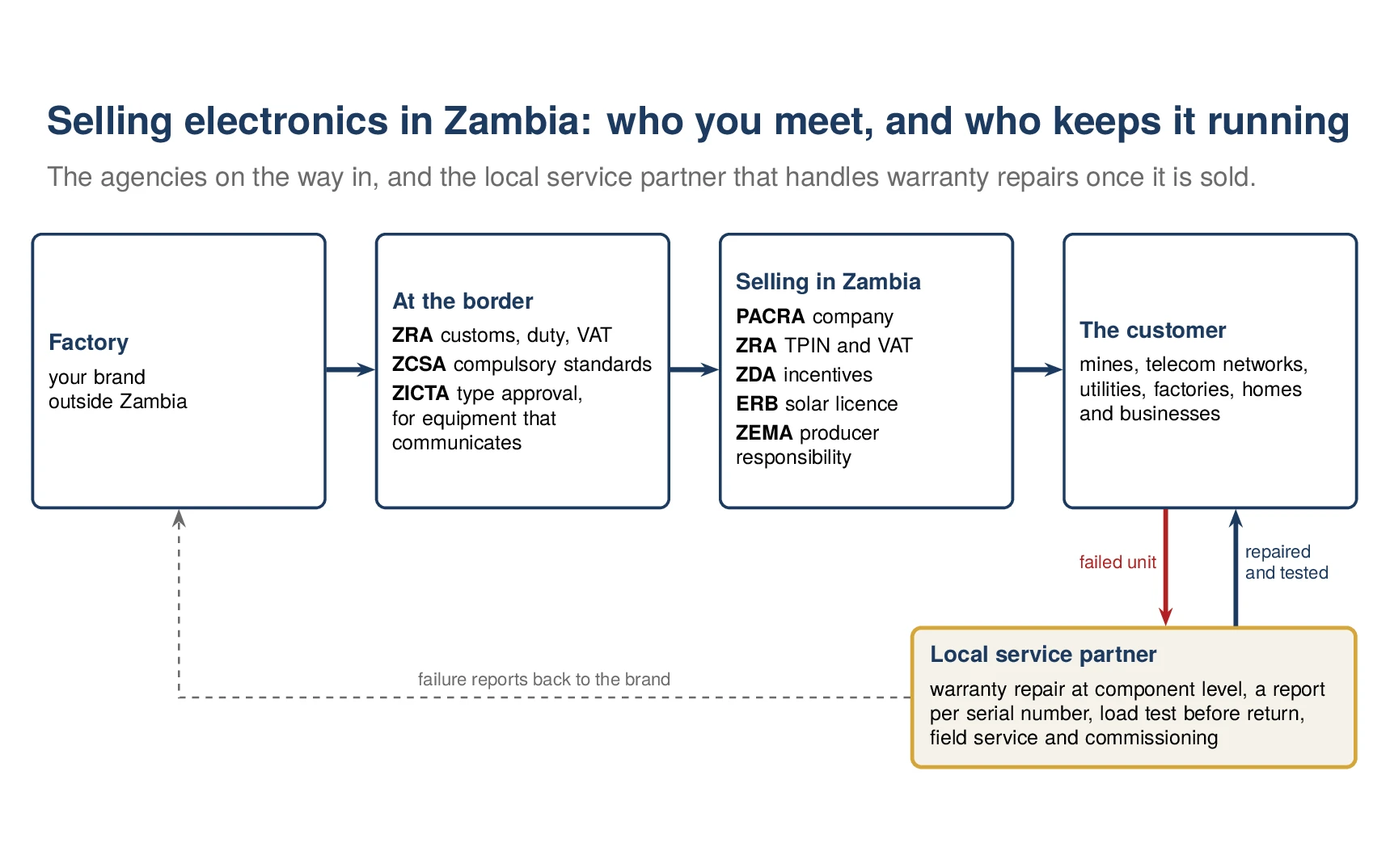
Zambia buys a lot of imported electronics: inverters and batteries for load-shedding, drives and controls for mines, and radio and power equipment for telecom networks. Getting a product into the country and onto the market is one job. Keeping it working once it is installed is another, and Zambian buyers ask about the second one early.
This guide is for manufacturers and distributors planning to sell electronics here, especially solar, battery, automation and telecom equipment. It lists the agencies you will deal with, what each one covers, and what a local service partner does. Every rule below comes from the agency named, as published in November 2026. Rules change with new regulations and budgets, so confirm the details with the agency before you rely on them. The sources are listed at the end.
The agencies at a glance
| Agency | What it covers | When it applies to you |
|---|---|---|
| PACRA | Company registration | You set up your own company or branch in Zambia |
| ZRA | Tax registration (TPIN), VAT, customs duty | You import or sell in Zambia |
| ZDA | Investor registration and incentives | You want investment incentives |
| ZICTA | Type approval of electronic communications equipment | Your product communicates or connects to a network |
| ZCSA | Compulsory standards, checked at import | Your product is on ZCSA's list |
| ERB | Licence for solar businesses | You import, sell wholesale or install solar equipment |
| ZEMA | Extended producer responsibility | You import or distribute electrical and electronic equipment |
Many brands start by selling through a Zambian distributor, which holds most of these registrations itself. The ones that stay with the product, such as ZICTA type approval and ZCSA standards, still have to be met whoever imports it.
Registering a business: PACRA and ZRA
- PACRA (the Patents and Companies Registration Agency) registers companies under the Companies Act, 2017, including foreign companies that set up a place of business in Zambia.
- ZRA (the Zambia Revenue Authority) issues the tax number, the TPIN. For a company registered with PACRA after 2020, ZRA says the TPIN is generated when the PACRA registration is completed. A non-resident company registers for a TPIN with its PACRA certificate of registration and PACRA's Form 38.
- VAT: ZRA's standard rate is 16%. Some supplies are zero-rated and some are exempt, so check how your products are treated.
Investment incentives: ZDA
- Under the Investment, Trade and Business Development Act, 2022, a business is eligible for incentives only if it holds a licence, permit or certificate issued under that Act. Incentives go to registered businesses investing in priority sectors, as prescribed.
- The Zambia Development Agency (ZDA) has to approve or reject an application within 30 days, under the same Act.
- ZDA's incentives page says fiscal incentives apply to investments of at least US$500,000 in a multi-facility economic zone, an industrial park, a priority sector or a rural enterprise, and non-fiscal incentives from US$250,000.
- ZDA issues an investor certificate of registration, to foreign and local investors, through its e-services portal.
Type approval: ZICTA
This is the one that catches equipment makers out. Under the ICT Act No. 15 of 2009 and the ICT (Type Approval) Regulations, Statutory Instrument No. 6 of 2011, any electronic communications equipment intended for use, supply, sale, lease or hire in Zambia must be approved by ZICTA, the Zambia Information and Communications Technology Authority.
- That clearly covers radios, network equipment and terminals. Many other products now contain a radio too, such as an inverter with a Wi-Fi or cellular monitoring module, or a controller with Bluetooth. If your product transmits, ask ZICTA whether it needs approval before you ship.
- The draft guidelines make each approval specific to a make and model.
- The draft guidelines' application form lists the kinds of applicant: an international or local manufacturer, an authorised dealer, a licensed operator or a commercial user.
The guidelines are being revised now. On 21 October 2026, ZICTA published draft revised type approval guidelines for comment until 20 November 2026. Once published, they will replace the 2022 guidelines. ZICTA lists these as the main changes:
- equipment classified as high risk or low risk;
- equipment allowed to be released from customs on conditions, pending type approval, in prescribed circumstances;
- quarantined equipment stored at a designated facility, at the importer's cost, for up to 60 days;
- categories of prohibited equipment, and a list of equipment exempt from type approval;
- wider labelling requirements for approved equipment.
ZICTA specifically invites comments from equipment manufacturers and their local agents. If you plan to sell communicating equipment in Zambia, read the draft on ZICTA's website.
Standards at the border: ZCSA
The Zambia Compulsory Standards Agency (ZCSA) administers 102 compulsory standards under the Compulsory Standards Act. Products covered by them must meet the standard before they are supplied, and ZCSA checks imports at the main border posts and through a central processing centre.
- Solar items were added in 2025. Statutory Instrument No. 20 of 2025 made these standards compulsory:
- ZS 403, batteries for use in photovoltaic systems;
- ZS 404, charge controllers for photovoltaic systems using lead-acid batteries;
- ZS 405, the code of practice for designing and installing off-grid photovoltaic systems;
- ZS 407, lighting devices for use in photovoltaic systems.
- Older electrical standards on the list cover lead-acid batteries, the safety of household electrical appliances, plugs and socket outlets, and electric cables.
- When we checked ZCSA's published list in November 2026, it did not include inverters or photovoltaic modules as such. Check the current list for your exact product.
ZCSA offers three ways to clear regulated goods:
- batch clearance, for each consignment;
- a pre-import scheme, which declares six months of imports and is inspected twice in that period;
- an annual import quality certificate, for importers whose last four consecutive consignments passed inspection.
Statutory fees apply to all three.
Customs duty and solar relief: ZRA
- Duty suspensions: Zambia suspends customs duty on many solar and electrical products through statutory instruments, and the list changes with budgets.
- Where to look:
- The Customs Handbook for Solar PV Products in Zambia (2024) was produced with the Ministry of Energy and ZRA. It lists the HS codes and the instrument that suspended each one.
- ZRA publishes its current Customs Tariff Book on its website.
- Before you set a price: confirm the duty and VAT treatment of each HS code with ZRA or a licensed clearing agent. Don't assume an exemption that applied to someone else's shipment last year applies to yours.
Solar businesses: an ERB licence
The Energy Regulation Board (ERB) licenses solar businesses. Its licence covers manufacturing, wholesale importing and installing solar energy and energy-efficient devices.
- What the application needs:
- a Zambian certificate of incorporation or registration;
- a valid ZRA tax clearance certificate;
- a business plan;
- audited accounts and proof of funds.
- What the technical inspection looks at:
- the competence of your technical staff;
- how well you know the applicable standards;
- a workshop with tools, if you will do repairs.
In other words, the regulator looks at after-sales capability as well as sales.
End of life: ZEMA
The Environmental Management (Extended Producer Responsibility) Regulations, Statutory Instrument No. 65 of 2018, list "electrical and electronic equipment" and "used lead-acid batteries" among the products they cover. Anyone who intends to manufacture, retail, import, trade or distribute a listed product in Zambia must apply to the Zambia Environmental Management Agency (ZEMA) for registration at least one month before starting. Ask ZEMA how it applies the regulations to your product category today.
Why buyers ask about after-sales first
Mines, telecom operators and water utilities run equipment around the clock. A failed drive stops a pump or a conveyor, and a failed rectifier takes a tower site down when its batteries run flat. When a unit fails, the buyer's question is how quickly it can be working again.
- Import lead time: importing a replacement typically takes 4–12 weeks, and it is paid for in foreign currency.
- Warranty returns: sending a failed unit back to the factory and waiting for a replacement can take as long. A local repair can take days.
- Procurement: the questions we hear from buyers are who repairs this in Zambia, how fast, under what warranty, and with what report.
A brand with no answer to those questions competes on price alone. A brand with a named local service partner can answer them in the tender.
What a local service partner does
- Warranty and out-of-warranty repair at component level, not only swapping boards, so you don't have to ship spare boards in for every fault.
- Returns handling: each unit logged on arrival with photos and its serial number, and a written failure report you can feed into your own quality data.
- Testing under load before the unit goes back to the customer.
- Field service: fault-finding on site, installation and commissioning.
- Training for your dealers' and customers' technicians.
- Escalation: when the same fault keeps appearing, evidence you can take to your engineers.
How HERO Control Systems works with brands
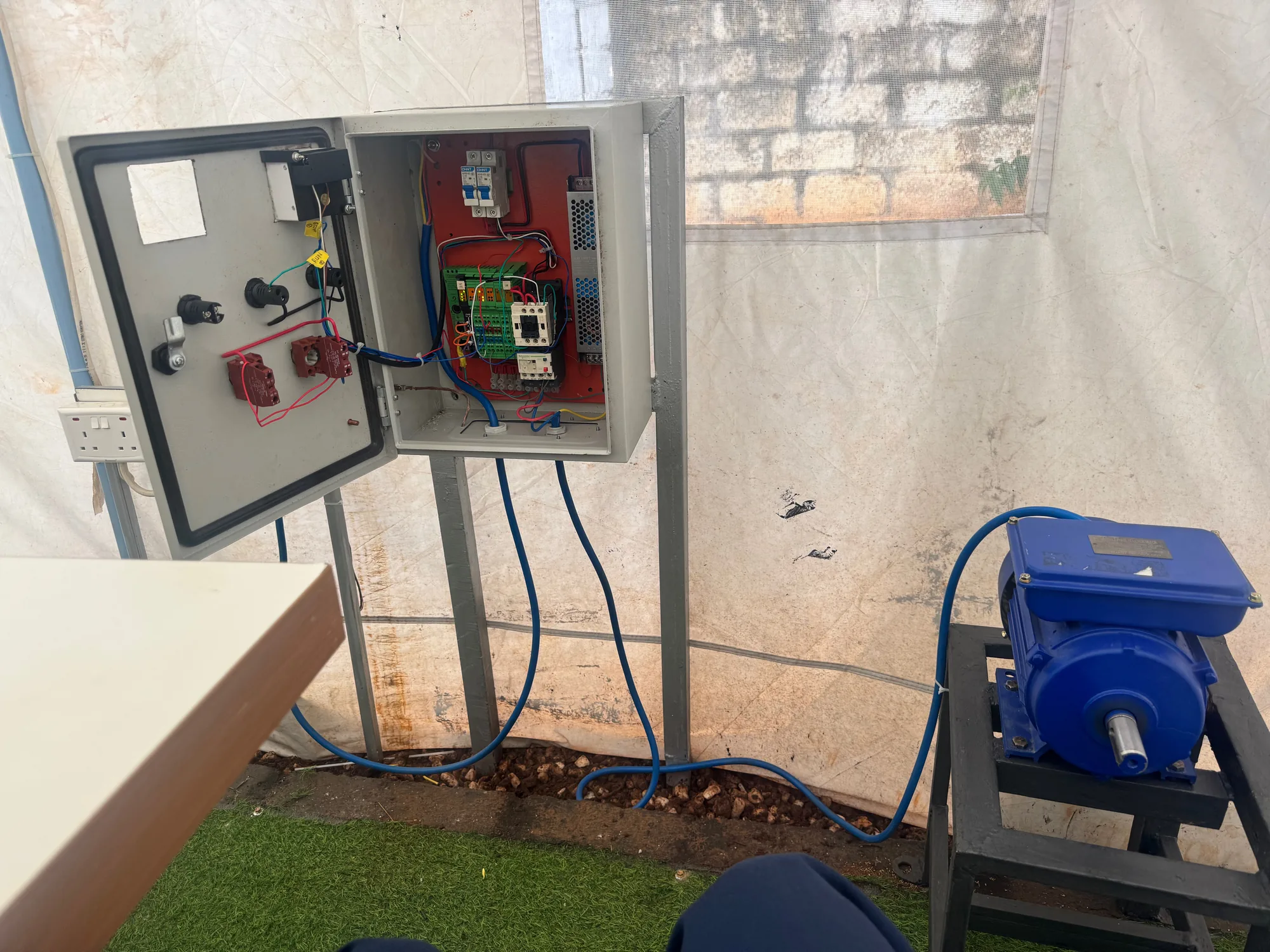
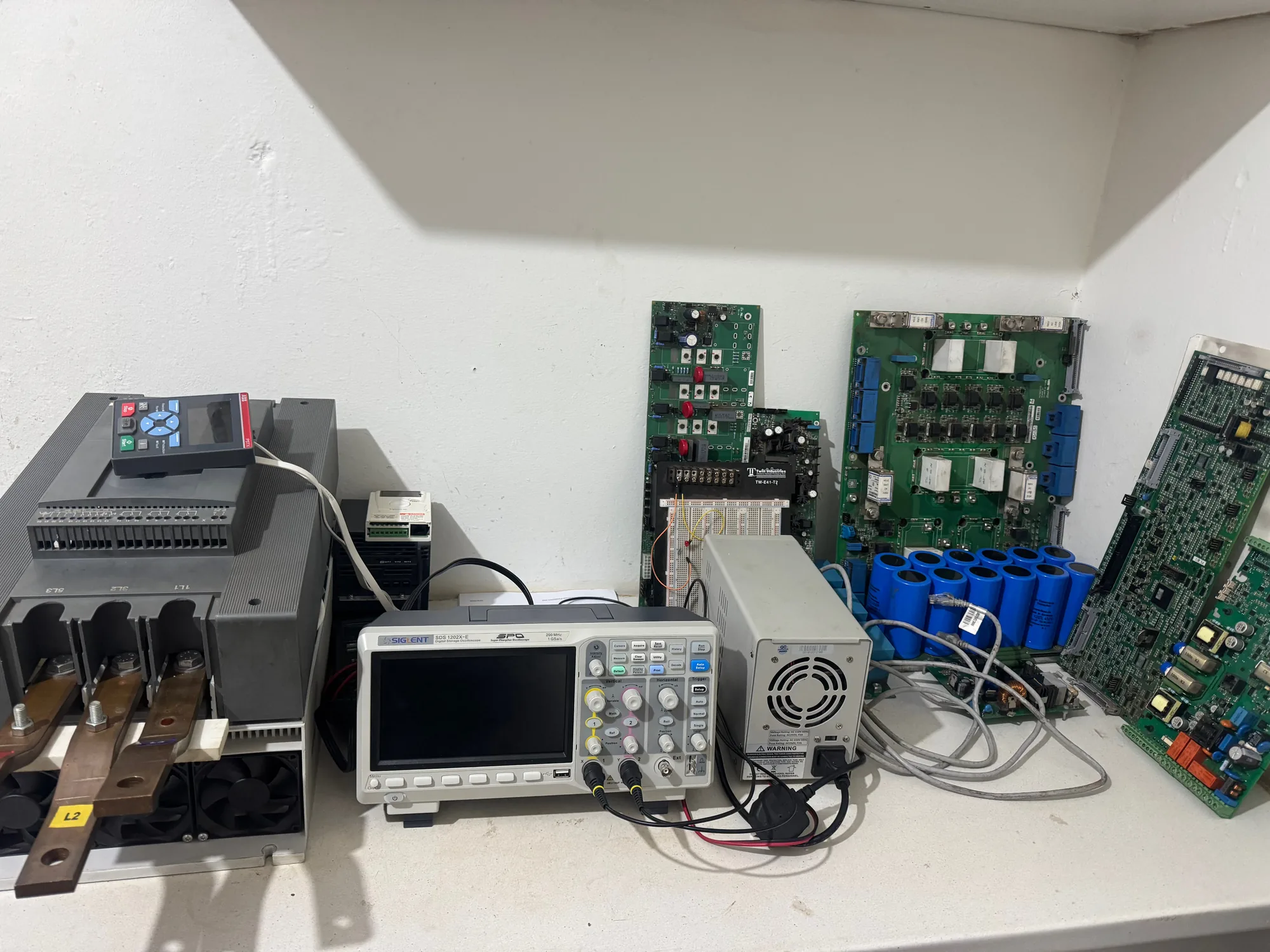
HCS is an independent engineering company in Lusaka. We repair power electronics, telecom and industrial equipment at component level, and we design replacement boards when parts are discontinued. For a brand entering Zambia, that means:
- a workshop in Lusaka, a presence on the Copperbelt, and site work across Zambia, and we have delivered work for JCHX Mining in Botswana;
- a written report per serial number, and load testing before every unit is returned;
- a 6-month workmanship warranty on repaired units;
- a standard turnaround of 5–7 business days, or 48–72 hours with priority under a maintenance agreement.
We work under a contracted repair framework with MTN Zambia, and high-end broadcast RF power amplifiers from MultiChoice transmitter stations have been on our bench. See our telecom repair work, rectifier repair, UPS and inverter repair and battery energy storage pages for the equipment we handle.
A checklist before your first shipment
- Decide whether you will register your own company (PACRA, ZRA) or sell through a Zambian distributor.
- If any product transmits or connects to a network, check ZICTA type approval for each model.
- Check ZCSA's list of compulsory standards for each product.
- Confirm the duty and VAT for each HS code with ZRA.
- For solar, make sure whoever imports and installs holds an ERB licence.
- For electrical and electronic equipment, ask ZEMA about producer-responsibility registration.
- Name your after-sales partner, and agree turnaround, warranty handling and reporting before the first tender.
Looking for a local service, repair or commissioning partner in Zambia? See how we work with global brands, or contact us.
Sources (checked November 2026)
- ZICTA, public notice on the draft revised type approval guidelines, 21 October 2026, and the draft guidelines published with it
- PACRA, company registration
- ZRA, business registration requirements, tax information (VAT) and Customs Tariff Book
- ZDA, investment incentives and e-services
- Investment, Trade and Business Development Act, 2022 (ZambiaLII)
- ZCSA, list of compulsory standards and import quality monitoring
- ERB, renewable energy and solar importers registration
- Environmental Management (Extended Producer Responsibility) Regulations, 2018 (ZambiaLII)
- Ministry of Energy and ZRA, Customs Handbook for Solar PV Products in Zambia (2024)