A Plain-English Introduction to Modern Embedded Programming
What is embedded software, and why does it matter?
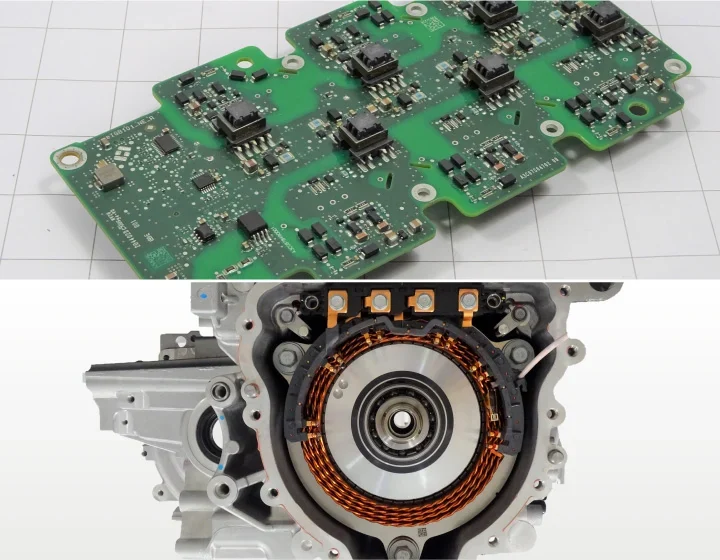
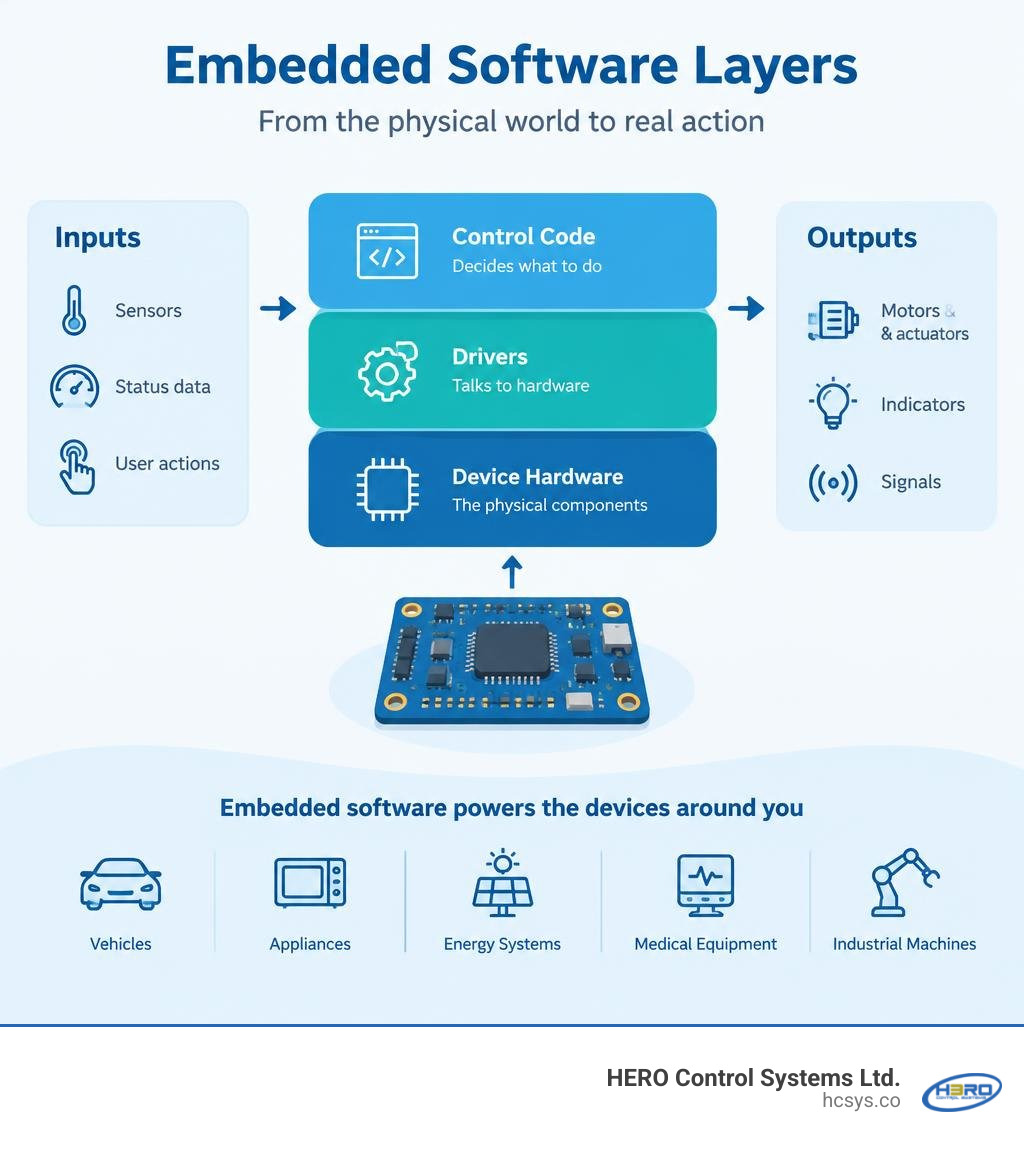
Embedded software is code built into a device to control a specific job. It reads inputs, such as sensor data, and tells the hardware what to do. Unlike a desktop app, it is designed for a particular machine and may need to respond within strict time, memory, and power limits.
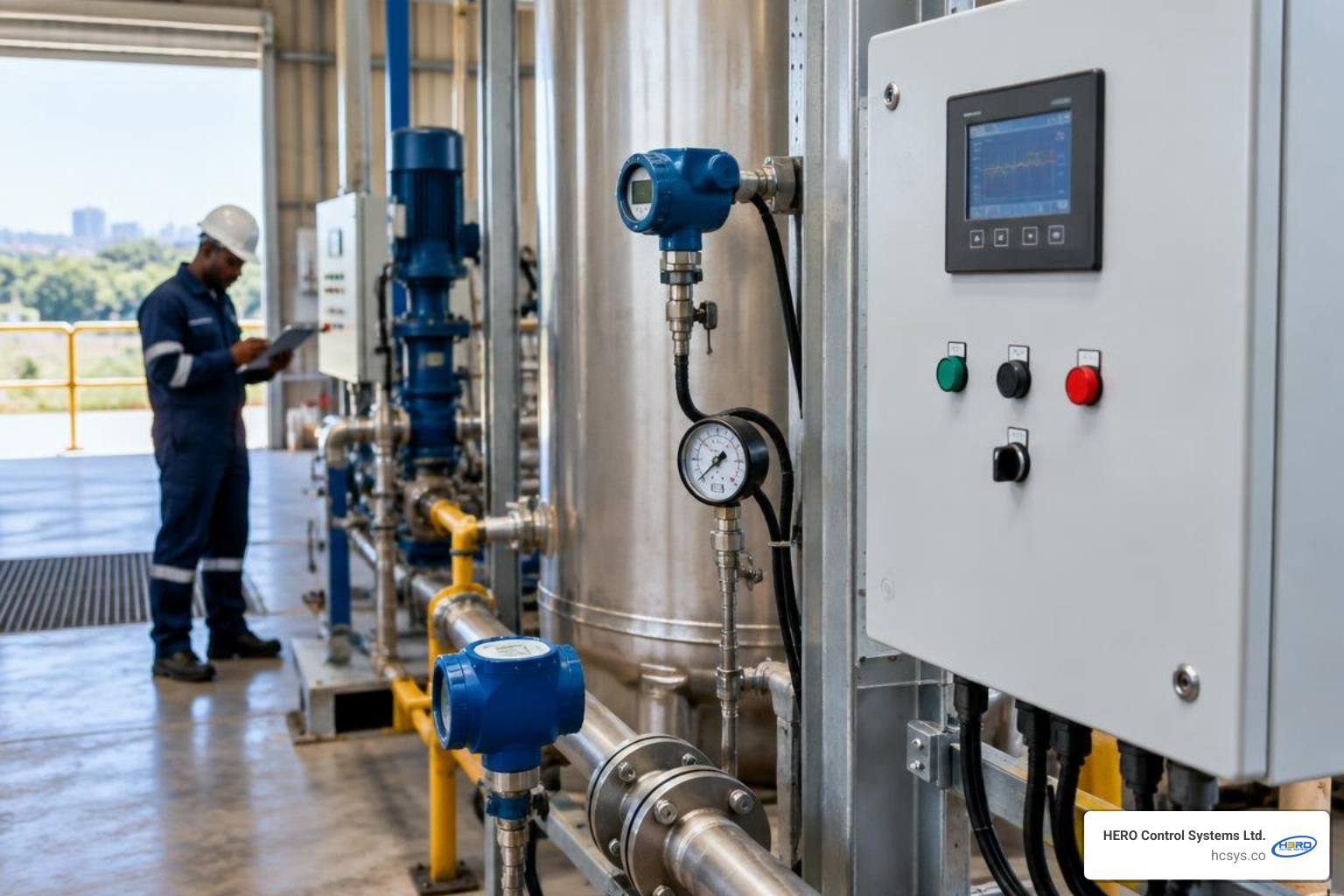
Think of a pump controller: its software can monitor a sensor and switch the pump off when a fault occurs. That response matters when a delay could damage equipment or stop work.
I’m Eng. Cephas Kalembo, founder and CTO of HERO Control Systems Ltd., with over a decade of experience in PCB design, embedded firmware, and industrial electronics repair. I’ll use that hands-on experience to answer “what is embedded software” and explain how its parts work together.
Understanding What Is Embedded Software and How It Works
To understand Embedded software, we have to look past the screens, mice, and keyboards we normally associate with computers. Most computing chips manufactured today live inside physical equipment: vehicle anti-lock braking systems, microwave ovens, solar inverters, medical ventilators, and factory robotics.
At its core, embedded software is specialized code written to directly manage hardware components and perform a single dedicated function or a tightly defined set of tasks. Unlike general-purpose software running on personal computers or cloud servers, embedded programs operate within systems where computing power is deeply integrated into the physical machine.
To appreciate how this works, consider the fundamental distinction between the two primary brains used in these systems:
- Microcontrollers (MCUs): These are self-contained systems-on-a-chip. An MCU integrates a processor core, program memory (Flash), volatile working memory (RAM), and input/output peripherals (such as timers, digital pins, and analog converters) onto a single silicon die. They draw tiny amounts of power, cost little to produce, and excel at direct hardware sensing and actuation.
- Microprocessors (MPUs): These consist strictly of the central processing unit (CPU). An MPU requires external RAM chips, flash memory storage, and peripheral support chips on the board. They offer vastly higher clock speeds and computational throughput, making them ideal for high-bandwidth tasks like video streaming or complex gateway processing.
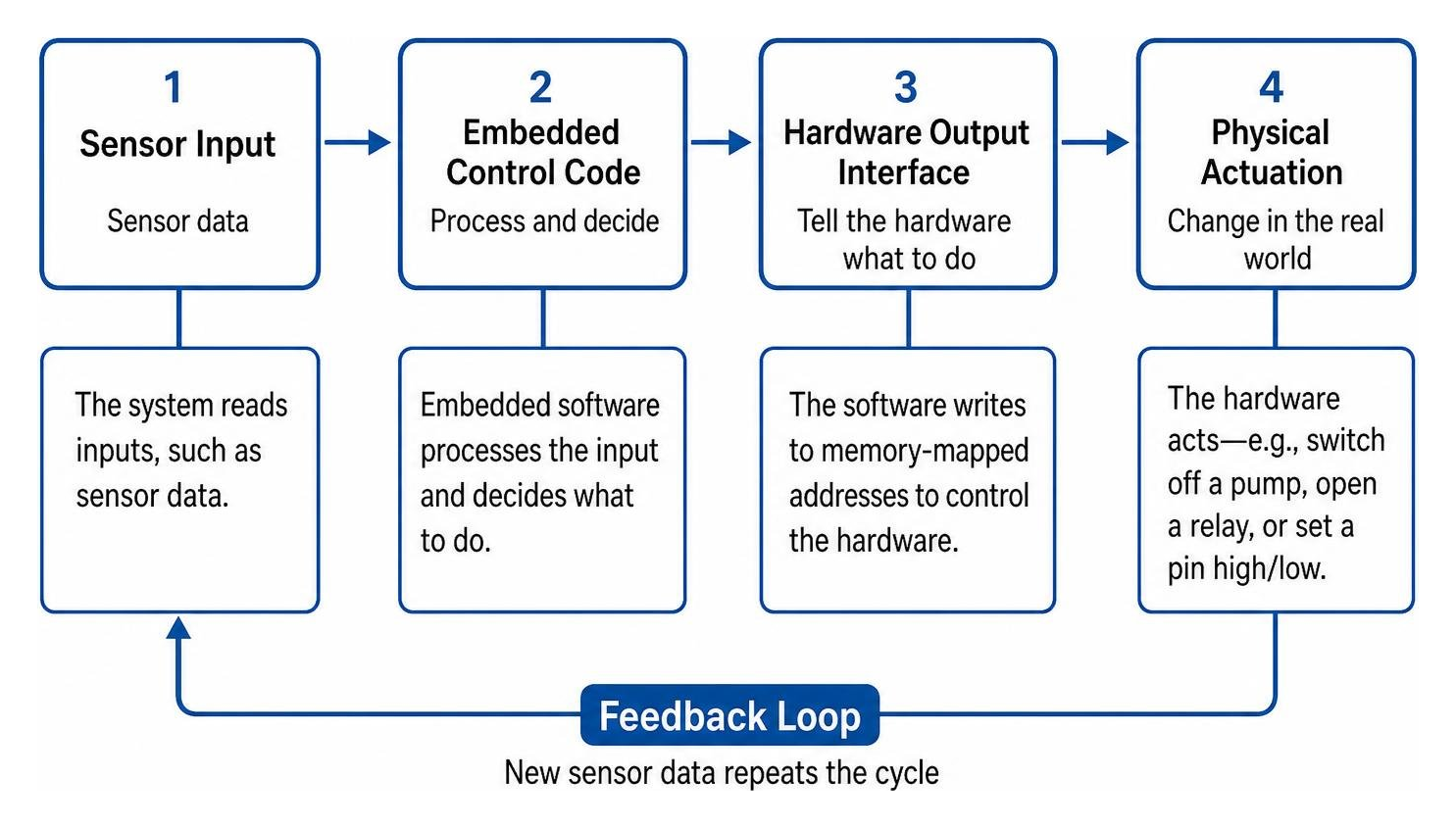
Embedded software interacts with these chips using a technique called memory-mapped I/O. In simple terms, the chip designer maps the physical hardware pins, internal timers, and communications hardware directly to specific digital memory addresses. When our embedded code writes a value to a particular memory address, it is not storing text or data in a spreadsheet; it is physically altering an electrical voltage on a pin, opening a relay, or configuring a clock circuit.
What Is Embedded Software vs Application Software?
General-purpose application software—such as a word processor, video game, or web browser—is written to run on powerful computers managed by sophisticated operating systems like Windows, macOS, or Linux. The application developer rarely worries about which exact memory addresses are accessed, how many milliwatts of electricity the CPU uses while checking a loop, or what happens if a routine finishes two milliseconds late.
Embedded systems operate under completely different rules. We frequently write embedded programs that run on chips with as little as 16 KB of Flash memory and 4 KB of RAM, driven by a CPU running at a modest 8 MHz. In these resource-constrained environments, dynamic memory allocation can lead to fragmentation and system crashes, so every byte of memory is mapped deliberately during compilation.
| Architectural Feature | Embedded Software | General-Purpose Application Software |
|---|---|---|
| Primary Objective | Controls dedicated hardware to execute specific real-world tasks | Executes user-driven tasks across varied hardware platforms |
| Hardware Coupling | Tightly coupled to specific chip architectures and pinouts | Abstracted away via rich OS layers and standard runtime environments |
| User Interface | Often headless (no screen), or limited to simple LEDs and buttons | Rich graphical user interfaces (GUIs), touchscreens, and web browsers |
| Resource Footprint | Measured in kilobytes (KB) to low megabytes (MB) of RAM/Flash | Measured in gigabytes (GB) of RAM and terabytes of solid-state storage |
| Execution Timing | Deterministic and real-time; response latency must be guaranteed | Best-effort; minor execution delays or UI pauses are tolerated |
| Storage Medium | Non-volatile on-chip ROM, Flash, or EEPROM | High-capacity SSDs, HDDs, or remote cloud storage infrastructure |
Furthermore, embedded programs are built for autonomous, continuous operation. An application on your laptop can show an error pop-up and wait for you to restart it. An embedded controller deep inside a mining borehole or a patient's pacemaker must run for years without human intervention, handling power brownouts, sensor noise, and unexpected exceptions cleanly without ever freezing.
The Distinction Between Embedded Software and Firmware
In engineering discussions, the terms "embedded software" and "firmware" are frequently used interchangeably, but there is a helpful distinction based on architectural depth.
According to technical literature on What Is Firmware and How Does It Work?, firmware represents the foundational, semi-permanent software programmed directly into non-volatile memory (such as ROM, PROM, or Flash memory) that gives a piece of hardware its basic operational identity. Firmware initializes the processor, sets clock speeds, stabilizes power rails, and configures the lowest-level registers when the device turns on.
Embedded software is a broader category that encompasses everything running on an embedded device. This includes:
- Low-Level Firmware and Bootloaders: The minimal code that executes upon power-on to initialize memory, verify cryptographic signatures, and jump to the main control routine.
- Device Drivers and Board Support Packages (BSPs): Code modules that abstract physical peripherals (like a digital temperature sensor or an electric motor driver) into clean programming interfaces.
- Application Logic / Middle-tier Software: The higher-level business rules, control algorithms (such as PID loops for motor control), telemetry state machines, and networking stacks.
When troubleshooting legacy systems or engineering modern hardware replacements, resolving low-level operational failures requires a dual understanding of circuit traces and board code, which we frequently address in our practical guide on firmware troubleshooting and design.
Architecture, Operating Environments, and Programming Languages
To build software that interacts reliably with physical electronics, developers organize code into structured layers. At HERO Control Systems, our engineers focus heavily on embedded research and development to ensure every software layer works in harmony with custom circuit architectures.
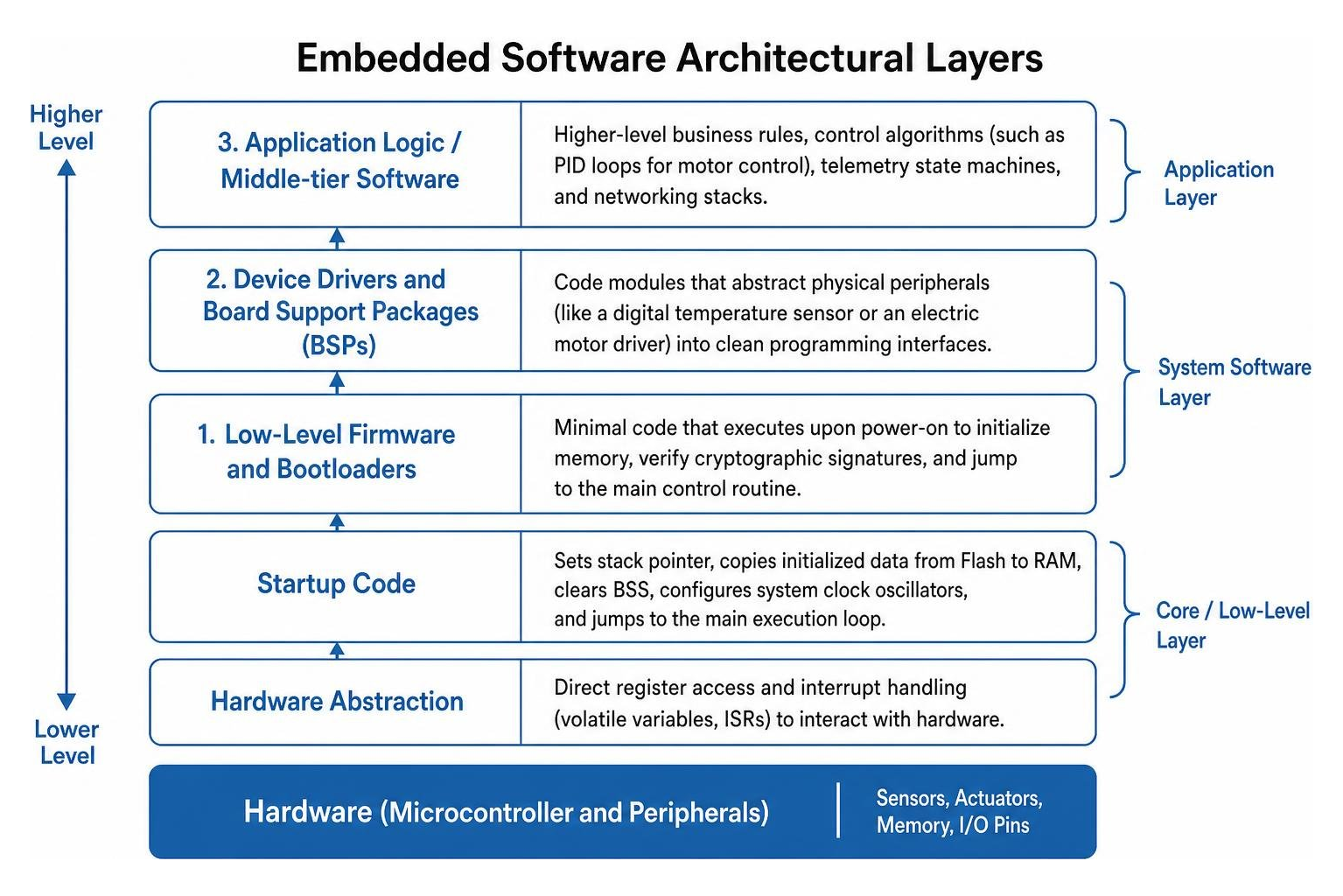
When power is applied to an embedded processor, it executes a tiny sequence of machine instructions known as the startup code. This routine sets the stack pointer in RAM, copies initialized variables from Flash into RAM, clears uninitialized memory regions (the BSS segment), configures system clock oscillators, and jumps directly into the main execution loop.
Inside this environment, low-level variables require special keywords. For example, the volatile keyword in C informs the compiler's optimizer that a memory address can change value at any moment outside the normal program flow—such as a register modified by an incoming hardware voltage change or an Interrupt Service Routine (ISR). An ISR is a high-priority function executed immediately by the CPU whenever a hardware peripheral (like a timer tick or a communications pin) demands immediate processing.
Bare-Metal Programming vs Real-Time Operating Systems (RTOS)
When structuring an embedded application, engineers generally choose between two execution models:
- Bare-Metal (Super-Loop) Execution: The program runs directly on the hardware without an underlying operating system. The architecture consists of an infinite
while(1)loop that sequentially checks flags, updates state machines, and executes tasks, while time-critical inputs are intercepted by hardware interrupts. Bare-metal designs offer minimal memory overhead, zero OS scheduling jitter, and complete execution visibility. However, as system complexity grows, managing multiple concurrent tasks without blocking the processor becomes challenging. - Real-Time Operating Systems (RTOS): For systems requiring complex multi-threading, networking stacks, and deterministic scheduling, an RTOS (such as FreeRTOS, Zephyr, or VxWorks) is introduced. An RTOS provides a lightweight multitasking kernel with a preemptive scheduler. Tasks are assigned strict priority levels; if a high-priority task needs to run, the scheduler pauses lower-priority tasks instantly.
In embedded development, real-time does not necessarily mean "blazingly fast"; it means deterministic. We divide these requirements into two categories:
- Hard Real-Time Systems: Missing a execution deadline leads to catastrophic system failure. Examples include vehicle airbag deployment, industrial turbine overspeed governors, and pacemakers. The response window must be guaranteed mathematically down to the microsecond.
- Soft Real-Time Systems: Meeting timing deadlines is desirable for quality of service, but an occasional missed deadline does not cause catastrophic destruction. Examples include digital audio streaming, user interface updates on a smart home display, or periodic environmental data logging.
Core Languages: C, C++, and Modern Alternatives
The choice of programming language in embedded software depends directly on resource limits, toolchain availability, and safety standards:
- C (The Industry Standard): C remains the dominant language for embedded engineering. It offers unmatched hardware access, allows direct pointer arithmetic to read and write physical memory registers, and generates predictable, compact machine code. In safety-critical sectors like automotive, medical, and aerospace, development teams adhere strictly to the MISRA C guidelines—a collection of defensive programming rules that prohibit risky constructs such as dynamic memory allocation, unbounded loops, and ambiguous type conversions.
- C++ (Modern and Object-Oriented): Modern embedded C++ (using C++17 and C++20 standards) has gained significant adoption. When features like heavy runtime type inspection and dynamic exceptions are disabled, C++ templates and zero-cost abstractions allow developers to write highly organized, modular driver code without paying a runtime memory or speed penalty.
- Assembly Language: Used sparingly today for specialized processor initialization, writing high-speed cryptographic primitives, context switching within RTOS kernels, or deeply optimized digital signal filtering loops.
- Rust: An emerging language in modern firmware design. Rust enforces memory safety and concurrency guarantees at compile time without requiring a garbage collector, eliminating common bugs like buffer overflows, dangling pointers, and race conditions.
- MicroPython and Embedded Python: High-level interpreted environments like MicroPython allow rapid prototyping on modern 32-bit microcontrollers. While too slow and memory-intensive for microsecond-level hard real-time control, they excel in educational hardware, test automation, and rapid IoT sensor connectivity tests.
Communication Protocols, Toolchains, and Licensing Models
Modern embedded devices do not operate in isolation. They communicate constantly with on-board sensors, peripheral integrated circuits (ICs), other circuit boards, and external cloud infrastructure. Choosing the right communication bus is a critical design decision:
- I2C (Inter-Integrated Circuit): A synchronous, two-wire serial bus (SDA for data, SCL for clock) that connects multiple low-speed peripheral chips (such as temperature sensors, real-time clocks, and EEPROMs) to a microcontroller over short board distances using unique device addresses.
- SPI (Serial Peripheral Interface): A synchronous, four-wire serial protocol (MOSI, MISO, SCK, CS) designed for high-speed, full-duplex data transfers between a master processor and peripherals like Flash memory chips, graphics displays, or SD cards.
- UART (Universal Asynchronous Receiver-Transmitter): An asynchronous, two-wire (TX/RX) serial interface commonly used for direct board-to-board communication, system command-line consoles, and GPS module interfacing.
- CAN Bus (Controller Area Network): A differential two-wire, message-based protocol engineered for harsh, electrically noisy environments. CAN bus includes built-in hardware collision resolution and error detection, making it the worldwide standard for automotive ECUs and industrial machinery.
- Industrial Ethernet and Wireless: Protocols such as Modbus TCP, EtherCAT, Wi-Fi, BLE (Bluetooth Low Energy), LoRaWAN, and cellular IoT connect edge nodes to broader networks. Keeping these physical communication channels operational is essential during ongoing telecom hardware and firmware maintenance.
Cross-Compilation, JTAG/SWD, and Hardware-in-the-Loop Testing
Writing embedded code requires a specialized toolchain. Because the target microcontroller lacks the resources to run a code editor, compiler, and linker, engineers use a cross-compiler running on a powerful host workstation (such as an x86-64 PC). The cross-compiler takes human-readable C/C++ source code and translates it into the specific binary machine instructions executed by the target processor architecture (such as ARM Cortex-M, RISC-V, AVR, or ESP32).
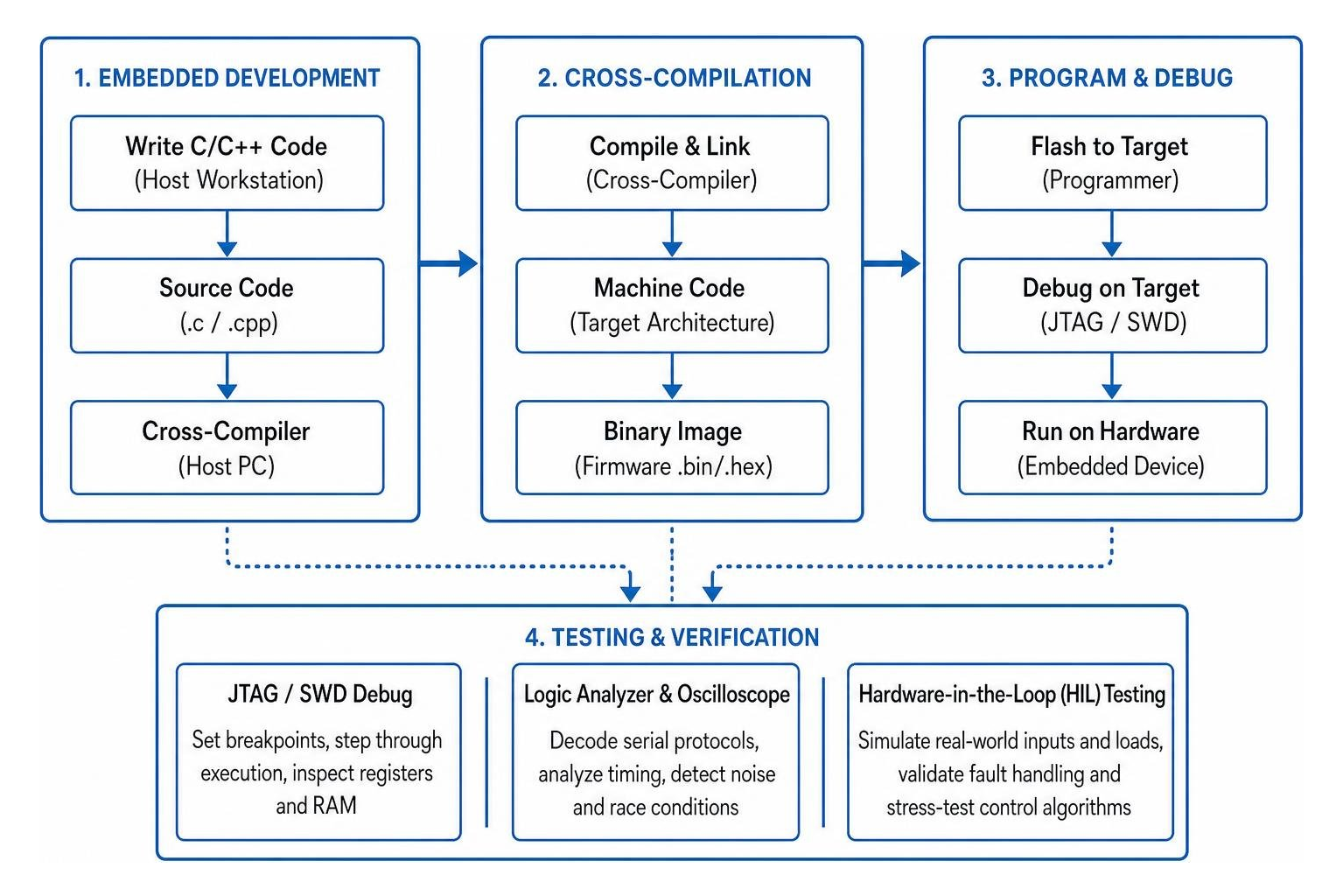
Once compiled into a binary image, the firmware is flashed to the physical chip and verified using specialized hardware tools:
- JTAG / SWD (Serial Wire Debug): Dedicated silicon-level debugging interfaces that allow engineers to set hardware breakpoints, step through firmware execution line-by-line on the live board, and inspect CPU registers and RAM contents in real time without halting peripheral clocks.
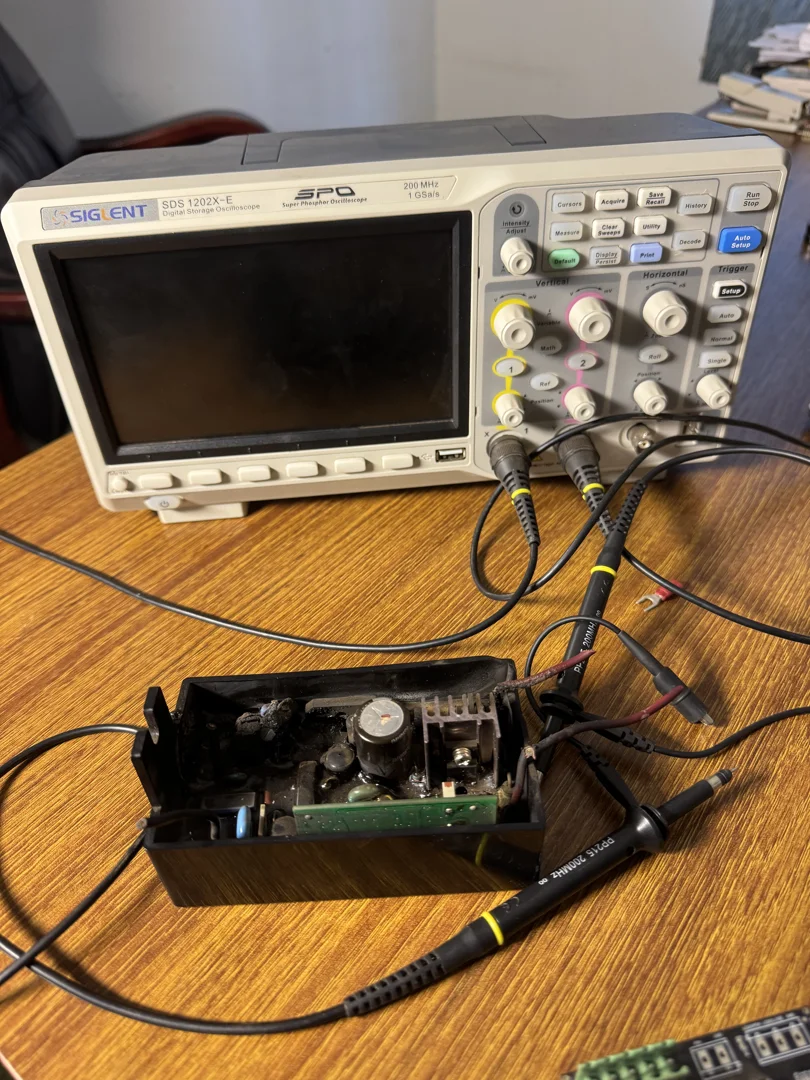
- Logic Analyzers and Mixed-Signal Oscilloscopes: Hardware instruments connected to physical PCB traces to decode serial protocol packets, analyze rise times, and identify electrical noise or timing race conditions that software alone cannot reveal.
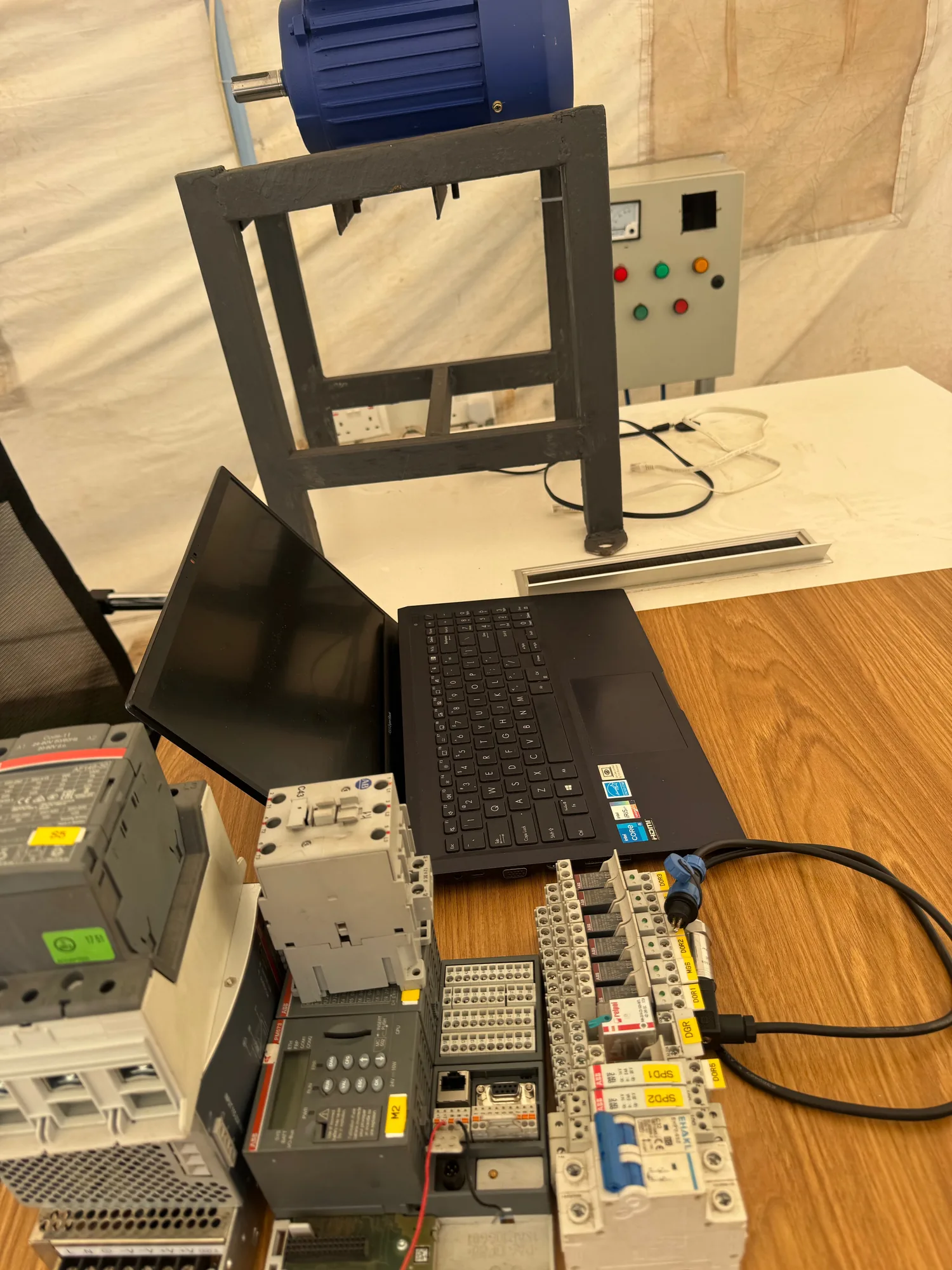
- Hardware-in-the-Loop (HIL) Testing: A testing methodology where the physical embedded controller is plugged into an automated test fixture that simulates real-world sensor inputs and electrical loads. This allows developers to validate complex fault-handling routines and stress-test control algorithms safely before deploying systems in the field, a practice central to our industrial automation diagnostics.
Licensing and Monetization in Embedded Systems
As hardware designs become increasingly standardized around off-the-shelf system-on-chip components, manufacturers increasingly rely on embedded software to differentiate products and monetize their intellectual property.
According to research on Embedded Software Licensing | What is Embedded Software Licensing, organizations deploy several distinct licensing structures:
- Proprietary Closed-Source: The manufacturer retains exclusive ownership of the compiled binary image, preventing unauthorized duplication or modification to protect proprietary algorithms.
- Open-Source Software (OSS): Using permissive (such as MIT, BSD, Apache 2.0) or copyleft (such as GPL) licenses. While open-source RTOS kernels and network stacks accelerate time-to-market, companies must manage license compliance carefully to avoid inadvertently exposing proprietary driver code.
- Feature-Based and Tiered Monetization: Using cryptographic keys stored in secure on-chip silicon enclaves, manufacturers ship identical physical hardware across product lines, enabling advanced features, processing bandwidth, or sensor channels only when customers purchase upgraded software licenses.
- Subscription and Cloud-Validated Licensing: Connected IoT devices validate active service subscriptions periodically over secure network channels, unlocking ongoing analytics or over-the-air firmware improvements.
Key Engineering Challenges and Career Outlook in 2026
Embedded software development requires navigating a balance between physical electronic constraints and software reliability. Unlike desktop applications, where computational resources are abundant, firmware engineers continuously address several core challenges:
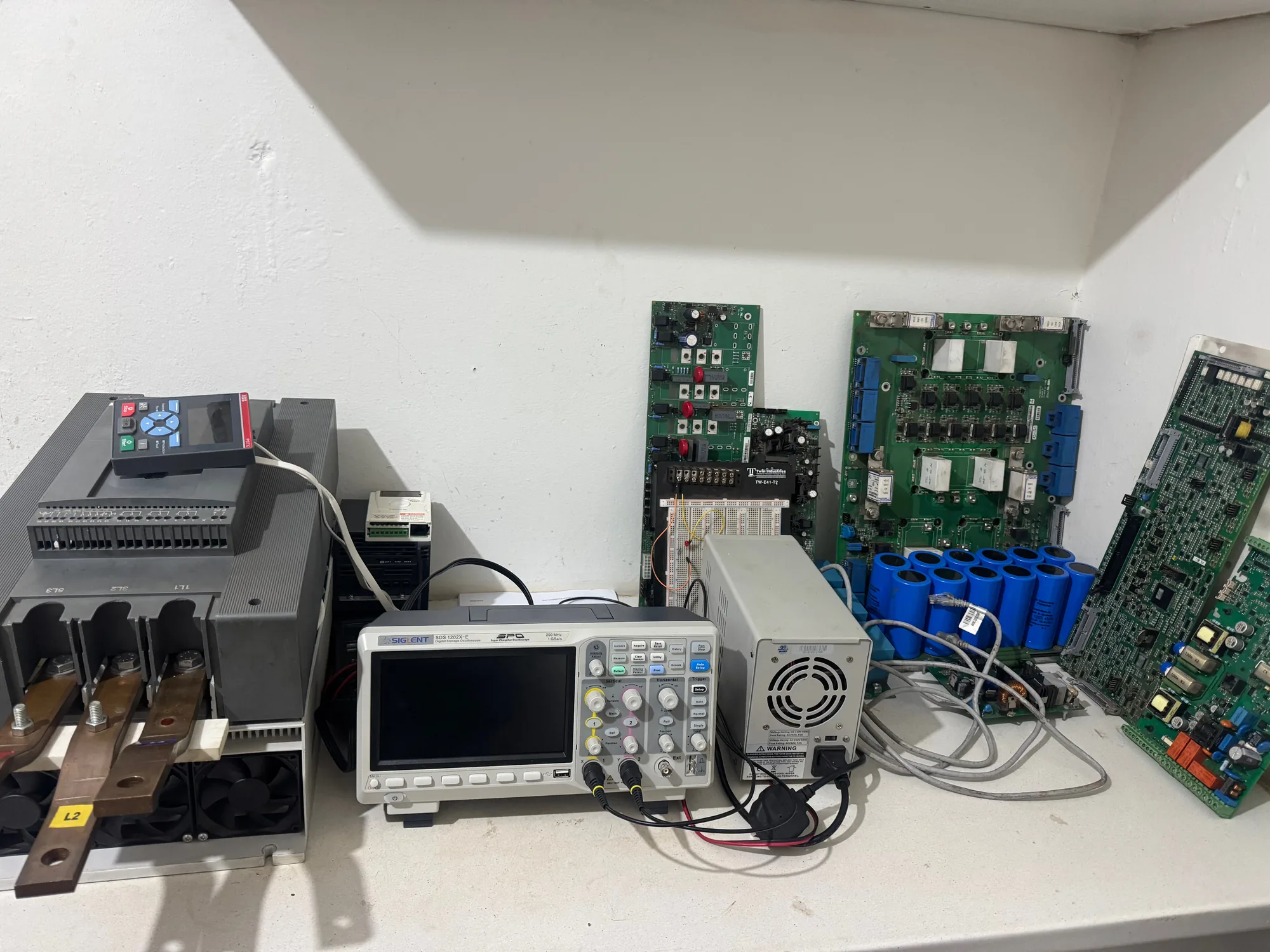
- Power Optimization and Battery Management: In battery-powered IoT devices and environmental sensors, extending operating life requires careful power management. Engineers program the microcontroller to remain in deep-sleep modes consuming mere microamps of current, waking via hardware timers or external sensor interrupts only long enough to sample data, transmit a packet, and sleep again.
- Fault Tolerance and Watchdog Recovery: Physical hardware operates in environments with electrical transients, voltage fluctuations, and cosmic-ray single-event upsets. Embedded software must implement internal hardware watchdog timers—independent counting circuits that automatically reset the processor if the software enters an infinite loop or fails to clear the timer within a set window.
- Memory Footprint and Stack Safety: With no virtual memory protection on smaller microcontrollers, dynamic memory allocation (
malloc) is generally avoided to eliminate memory leaks and heap fragmentation. Developers must calculate the worst-case stack usage carefully to prevent the execution stack from overwriting global variables in RAM. - Secure Remote Updates (OTA): Connected devices require secure Over-The-Air firmware updates. Designing robust dual-bank bootloaders ensures that if a power failure occurs midway through flashing a new image, the device falls back cleanly to the previous operational firmware image rather than becoming permanently unusable.
Building reliable embedded software requires a deep understanding of the underlying electronics. Designing clean board layouts that reduce electrical noise on communication lines is just as important as writing optimized code, which is why our team integrates firmware architecture directly with custom PCB design solutions.
Market Growth and Career Trajectory
The global embedded software market was valued at USD 20.7 billion in 2024 and is projected to expand at a compound annual growth rate (CAGR) of 9.6% through 2034. As intelligence is embedded into automotive drivetrains, medical monitors, renewable energy grids, and smart cities, the demand for qualified embedded engineers continues to rise.
Employment projections reflect this expansion. In the United States, job openings for embedded software developers are projected to grow by 26% over the 2021–2031 period, with regional technology centers like Washington state projecting software engineering growth of up to 37% through 2030. In major technology hubs, positions for embedded software engineers have doubled since 2018.
Compensation benchmarks demonstrate the value placed on cross-disciplinary hardware-software expertise. The median annual salary for embedded software engineers in the United States stands at $127,260, rising to $151,930 in high-demand regions like Washington state. In emerging international engineering hubs like India, annual compensation averages ₹7 Lakhs, ranging up to ₹12.9 Lakhs depending on specialized competencies in RTOS architecture, automotive safety standards, and wireless protocol design.
Bridging the gap between software design and physical electronics requires practical, bench-level experience. We support this through hands-on technical electronics training, helping engineers master schematic design, firmware programming, and hardware troubleshooting.
Frequently Asked Questions About Embedded Systems
What is embedded software and its main purpose?
Embedded software is specialized computer code programmed into microprocessors or microcontrollers within physical devices. Its main purpose is to orchestrate dedicated machine operations, read physical sensor data, control actuators (such as motors, valves, and displays), and maintain safe, autonomous device operation under strict timing, power, and memory limits.
Do all embedded systems require an operating system?
No. Many embedded systems operate using a "bare-metal" architecture, where code executes directly on the microcontroller without an operating system. Bare-metal designs are preferred for cost-sensitive, simple devices with tight memory constraints (such as simple motor controllers or smart plugs). An operating system, typically a Real-Time Operating System (RTOS) or embedded Linux, is introduced when the device requires complex multitasking, network stacks, advanced file systems, or deterministic multi-threaded scheduling.
How do embedded software engineers test code before hardware is fabricated?
Engineers use several virtualization techniques to develop and validate software early in the product lifecycle:
- Software Emulators and Virtual Platforms: Simulation environments (such as QEMU or vendor-specific CPU simulators) execute the target binary on a PC workstation, allowing driver logic and algorithms to be tested ahead of time.
- Hardware Mocking in Unit Testing: Software testing frameworks (such as Unity or Ceedling) allow developers to mock low-level hardware register calls, verifying business logic, communication parsers, and state transitions in software.
- FPGA Prototyping: Engineers program Field Programmable Gate Arrays to mimic the digital architecture of the final microcontroller or custom application-specific integrated circuit (ASIC).
Conclusion
Embedded software serves as the invisible bridge connecting mathematical logic to the physical world. From ensuring that an electric vehicle applies regenerative braking smoothly to regulating the precise thermal output of an industrial furnace, the quality of embedded code determines the safety, efficiency, and longevity of modern machines.
At HERO Control Systems, we combine decades of deep electronic design expertise with low-level firmware engineering to build end-to-end electronic products that perform reliably in demanding operational environments. Whether you are developing an innovative IoT product from the ground up or require robust firmware architecture for critical industrial applications, our engineering team provides end-to-end solutions. Explore our custom electronics design services to see how we can bring your next hardware innovation to life.