Fix Equipment Before It Breaks Using Predictive Maintenance Tech
How to Choose IoT Predictive Maintenance Software
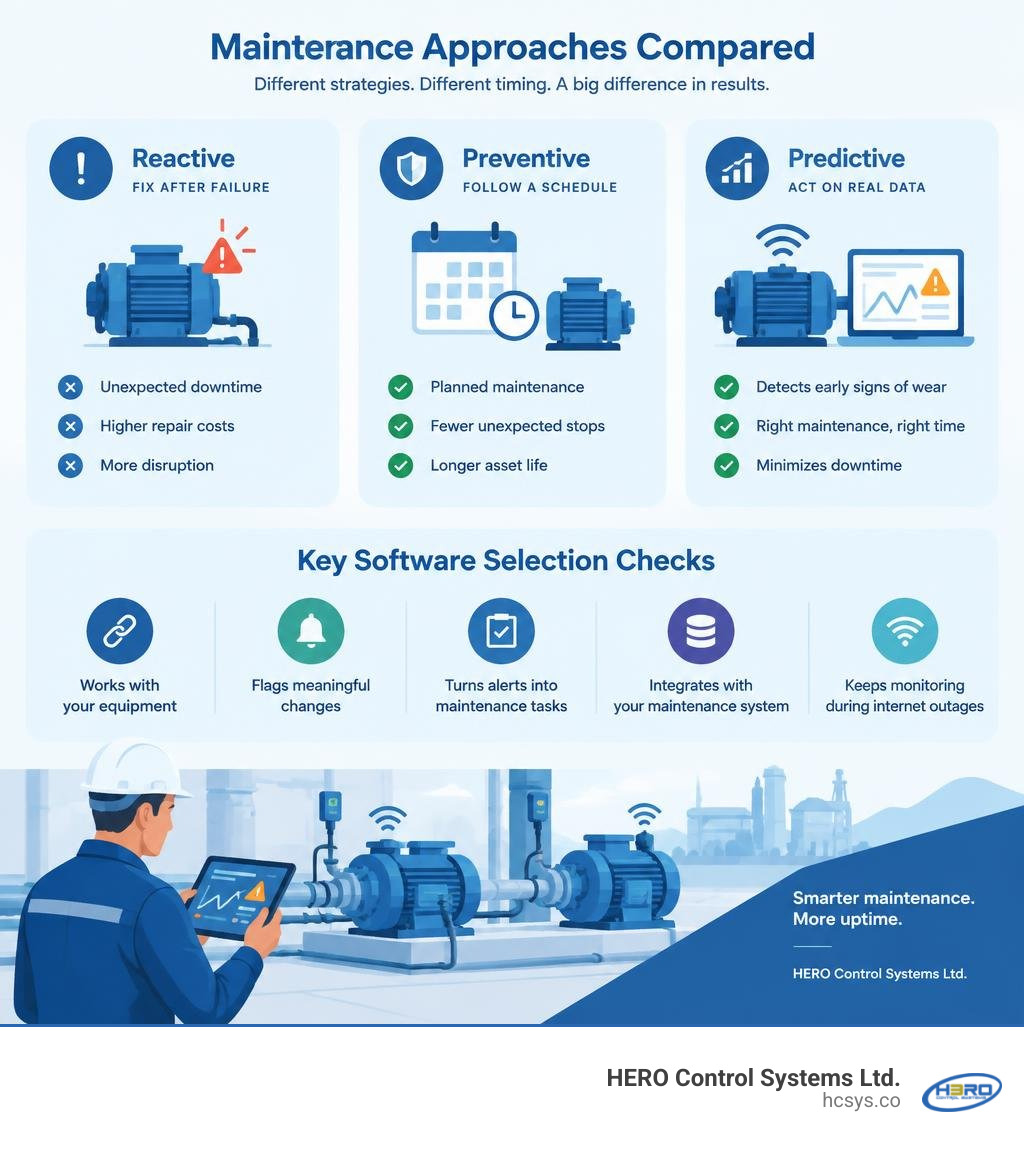
Choose IoT predictive maintenance software that works with your equipment, flags meaningful changes, and turns alerts into maintenance tasks. If you already use a maintenance system, check whether the software can send alerts and work orders to it. For a utility or mining site, also ask whether it can keep monitoring when the internet drops.
Unlike fixed-schedule maintenance, predictive maintenance uses sensor data to spot signs of wear before a breakdown. Start with one critical pump, motor, or other asset. That gives your team a way to test the alerts, the work involved, and the likely value before a wider rollout.
I’m Eng. Cephas Kalembo, founder and CTO of HERO Control Systems Ltd. My work in embedded firmware, IoT cloud platforms, and industrial electronics repair shapes how I evaluate IoT predictive maintenance software for real equipment and maintenance teams.
Core Architecture of IoT Predictive Maintenance Software
Modern predictive maintenance relies on a continuous flow of physical telemetry from field assets up into decision-making platforms. Rather than relying on static calendars, the software monitors physical phenomena—heat, vibration, current, acoustics—and compares live telemetry against learned baseline behaviors.
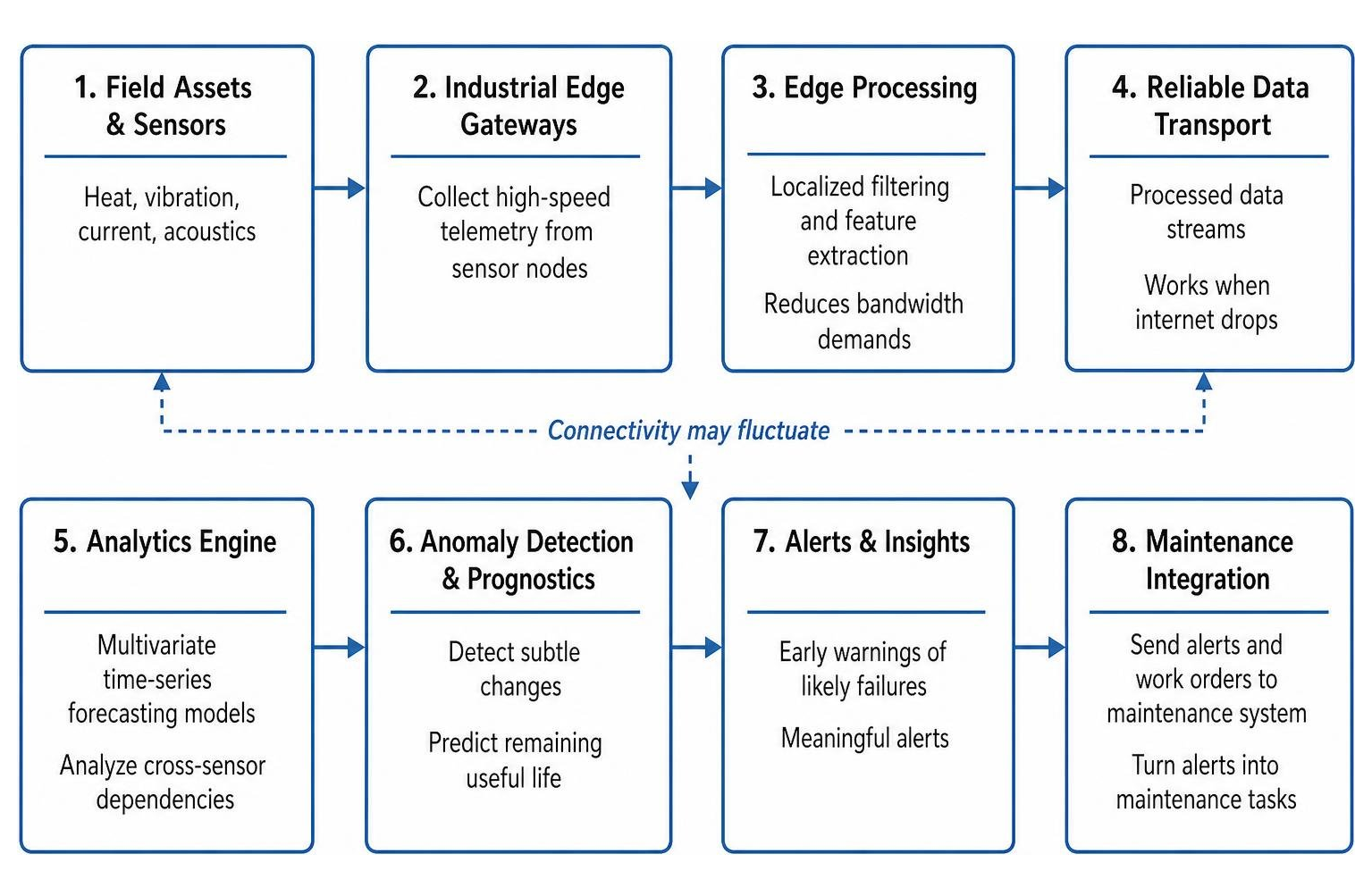
At the physical layer, industrial edge gateways collect high-speed telemetry directly from sensor nodes. Because raw industrial sensors generate massive streams of high-frequency data, edge nodes run localized filtering and feature extraction. This edge-level processing handles initial signal conditioning, reducing bandwidth demands and ensuring that time-critical anomalies register even when wide-area connectivity fluctuates.
Understanding how hardware handles these environments comes down to robust embedded engineering. At HERO Control Systems, our work in PCB and IoT firmware integration ensures field controllers capture micro-transients without dropping packets or drifting over time.
Once processed data streams reach the analytics engine, multivariate time-series forecasting models analyze cross-sensor dependencies. If a motor’s drive-end bearing registers a subtle rise in high-frequency vibration while its stator temperature simultaneously ticks upward under steady load, the platform recognizes the compound signature of early mechanical failure.
Rather than stopping at a dashboard alert, leading platforms integrate directly with Computerized Maintenance Management Systems (CMMS). When an anomaly score breaches defined thresholds, the software automatically opens a tracked work order, allocates spare parts from inventory, and dispatches field technicians.
Physical Sensor Layers and Data Acquisition
Accurate predictive analytics start with quality data capture at the physical equipment interface. Deploying the wrong sensor class or sampling at insufficient rates blinds the software to early mechanical degradation.
High-frequency triaxial accelerometers track acceleration, velocity, and displacement across three axes. Acoustic emission sensors operate in the ultrasonic spectrum (20 kHz to several hundred kHz) to capture sub-surface micro-cracking and lubrication breakdown long before heat or severe vibration manifest.
Complementary non-contact sensing provides a wider view across electrical panels and rotating mechanical housings. Routine thermal imaging inspection identifies localized hotspots caused by loose busbar terminations, failing contactor tips, or uneven bearing friction.
Simultaneously, Hall-effect current transducers sample AC motor feeds to perform Motor Current Signature Analysis (MCSA), identifying electrical and mechanical eccentricities without mounting transducers directly on hot or rotating mechanical surfaces.
AI Diagnostics, Digital Twins, and Cloud Integration
Raw sensor telemetry transforms into actionable maintenance guidance through machine learning models trained on baseline operating profiles.
When an asset is first instrumented, self-supervised learning algorithms ingest multidimensional operational data—speed, load, ambient temperature, line voltage, and vibration—to establish a baseline performance envelope. This baseline accounts for seasonal ambient shifts and dynamic production cycles, eliminating the constant false alarms that plague basic threshold-only systems.
As operational data accumulates, advanced platforms maintain a live digital twin: a synchronized virtual replica of the asset that continuously updates with incoming sensor feeds. By mapping live stresses against mechanical fatigue and thermal degradation curves, the system computes the asset's Remaining Useful Life (RUL).
Instead of vague warnings, maintenance managers receive precise forecasts: "Bearing 2B exhibits early inner-race spalling; expected functional life is 420 operating hours under current load before catastrophic seizure."
Key Diagnostics and Condition Monitoring Analysis Types
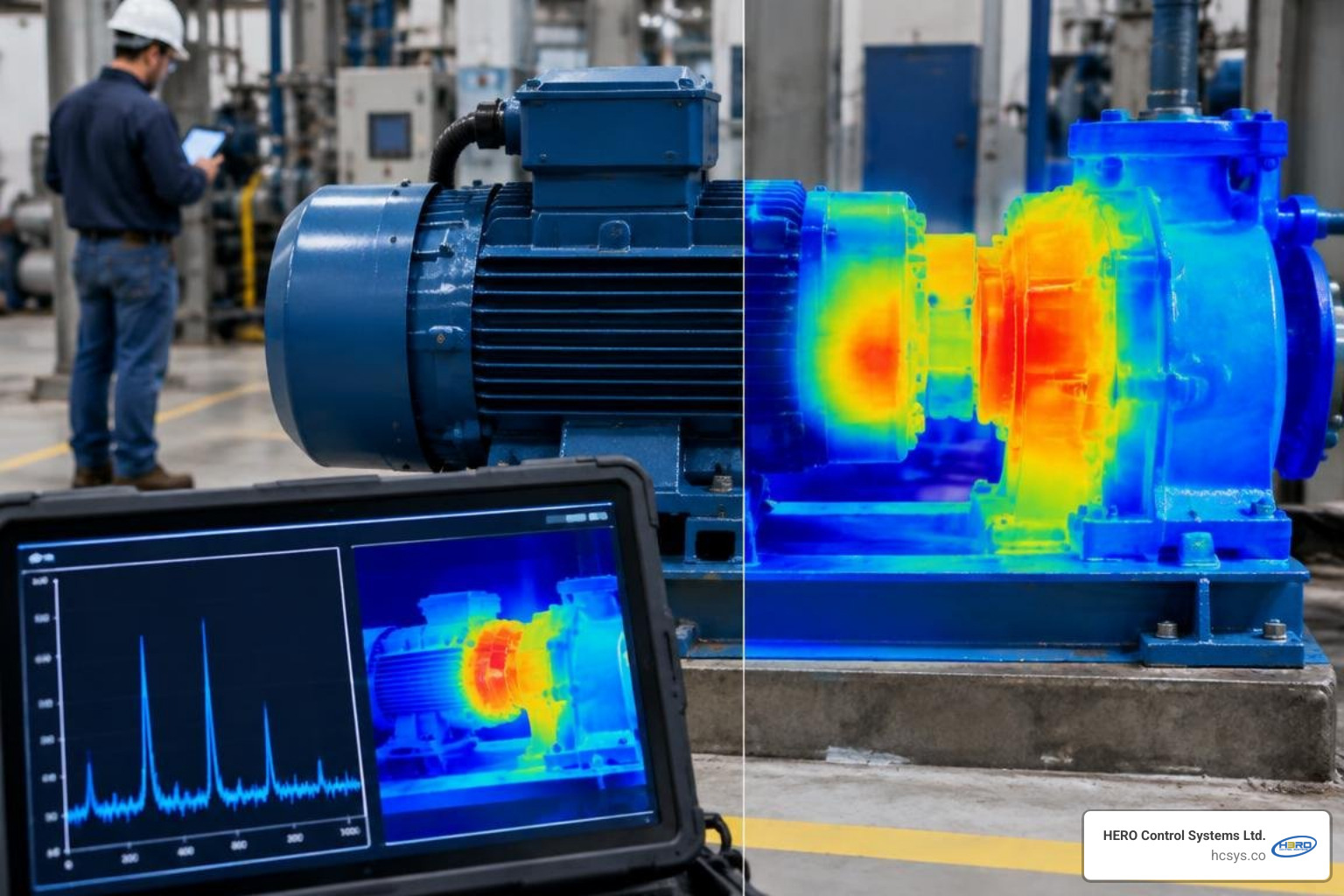
Industrial assets fail in predictable patterns when observed across the right physical domains. Relying on a single diagnostic method leaves blind spots; a balanced strategy layers vibration, thermal, acoustic, and fluid intelligence.
According to a report by the National Institute of Standards and Technology on condition monitoring-based technologies in industrial maintenance, adopting advanced predictive strategies significantly reduces component defects and unplanned shutdowns across asset-heavy operations.
In plant environments, early diagnostics help teams prevent widespread collateral damage. When anomalies appear in high-value drives, gearboxes, or power distribution units, pairing real-time analytics with experienced industrial repair diagnostics allows facilities to repair worn components before catastrophic mechanical failure damages surrounding plant assets.
Vibration and Acoustic Analysis for Mechanical Drive Systems
Mechanical drive trains—pumps, industrial fans, gearboxes, and overhead conveyors—exhibit distinct vibrational signatures throughout their operating lifecycle. Vibration analysis isolates these signals in both the time and frequency domains via Fast Fourier Transform (FFT) processing.
When a rolling element passes over a microscopic crack in an inner or outer race, it generates periodic impact pulses corresponding to specific kinematic defect frequencies:
- Ball Pass Frequency Outer Race (BPFO)
- Ball Pass Frequency Inner Race (BPFI)
- Ball Spin Frequency (BSF)
- Fundamental Train Frequency (FTF)
Gearboxes exhibit gear mesh frequencies (GMF) surrounded by sidebands when tooth wear, pitching, or backlash errors occur. High-frequency acoustic sensors detect cavitation in fluid pumps and micro-frictional wear due to grease dry-out before mechanical imbalance shows up on low-frequency velocity channels.
Drive trains powered by motor controllers present complex vibration spectra because operating speeds vary continuously. For facilities managing inverter-driven equipment, combining live telemetry with dedicated variable frequency drive maintenance ensures that harmonic distortions from electrical switching are not mistaken for mechanical bearing faults.
Thermography and Motor Current Signature Analysis
Electrical and power transmission systems exhibit failure modes through thermal buildup and current distortion rather than mechanical shaking.
Thermographic monitoring identifies high-resistance points across switchgear, motor junction boxes, and transformer windings. When contact surfaces oxidize or terminal lugs loosen, localized I²R electrical losses generate distinct thermal plumes.
Continuous infrared sensors track these temperature gradients against current load, catching loose terminal connections before phase arcs burn out the panel.
Motor Current Signature Analysis (MCSA) captures small fluctuations in the stator magnetic field. By tracking sideband frequencies around the fundamental supply frequency (50 Hz or 60 Hz), MCSA spots broken rotor bars, air-gap eccentricities, and stator winding short circuits while the motor remains fully loaded.
To turn these electrical readings into automatic machine interlocks, connecting your sensor stream to plant automation hardware is essential. Developing custom control logic through professional PLC automation integration lets plants automatically throttle back loaded drives or safely switch over duty pumps the moment electrical anomalies cross critical safety margins.
Evaluating and Selecting the Right Predictive Maintenance Platform
Evaluating software platforms requires balancing analytic depth, integration ease, hardware flexibility, and total cost of ownership. The market divides into three primary categories:
- Standalone Predictive Analytics Platforms: Focus entirely on advanced data ingestion, custom machine learning models, and deep anomaly detection. They ingest telemetry from existing SCADA, historians, and third-party gateways. They excel at complex diagnostic modeling across mixed equipment types but require integration with a CMMS to close the maintenance workflow loop.
- Bundled Hardware-and-Software Suites: Provide matched wireless sensors, pre-configured cellular/Wi-Fi gateways, and dedicated cloud analytics. Deployment is rapid because the vendor handles the full sensor-to-cloud path. However, you are locked into the vendor's sensor ecosystem and subscription models.
- Integrated CMMS Platforms with IoT Modules: Combine native work-order tracking, inventory management, labor scheduling, and direct sensor threshold monitoring. While their native ML diagnostic capabilities may be less specialized than pure-play analytics tools, they excel at operational execution by instantly turning raw telemetry breaches into dispatched work orders.
Evaluating Top IoT Predictive Maintenance Software Features
When shortlisting candidate software, prioritize operational features that directly reduce friction for field technicians and reliability engineers:
- Mobile Responsiveness & QR Asset Tagging: Field technicians need full platform functionality on ruggedized tablets and smartphones. Scanning an asset’s QR code should immediately pull up live sensor trends, open work orders, historical repair logs, and component schematics.
- Automated Work-Order Generation: The platform must translate statistical anomaly alerts into actionable, pre-populated work orders with assigned priority levels, task checklists, and necessary replacement parts.
- Industrial Protocol Interoperability: Ensure the software ingests standard industrial protocols, including Modbus TCP/RTU, OPC-UA, MQTT, and REST APIs, allowing connection with existing PLCs, DCS systems, and legacy historians.
- Multi-Tenant Cloud and Edge Architectures: For multi-site operators, the software must provide role-based access control (RBAC), multi-site dashboard aggregation, and localized edge processing to maintain monitoring during connectivity drops.
Deployment Costs, Security, and Data Sovereignty
Connecting operational machinery to software introduces cybersecurity risks and ongoing licensing costs that must be planned for early.
Software architectures that support offline edge processing allow mission-critical algorithms to run locally on field hardware. The platform stores telemetry during network outages and synchronizes with the central cloud once links recover, maintaining continuous asset protection across remote substations or underground works.
Step-by-Step Implementation Strategy for Industrial Plants

A successful predictive maintenance program does not begin with an all-at-once plant-wide rollout. Trying to connect hundreds of unclassified machines simultaneously creates data noise, overwhelms maintenance teams with unfamiliar alerts, and strains budgets before value is demonstrated.
A disciplined implementation follows a phased roadmap:
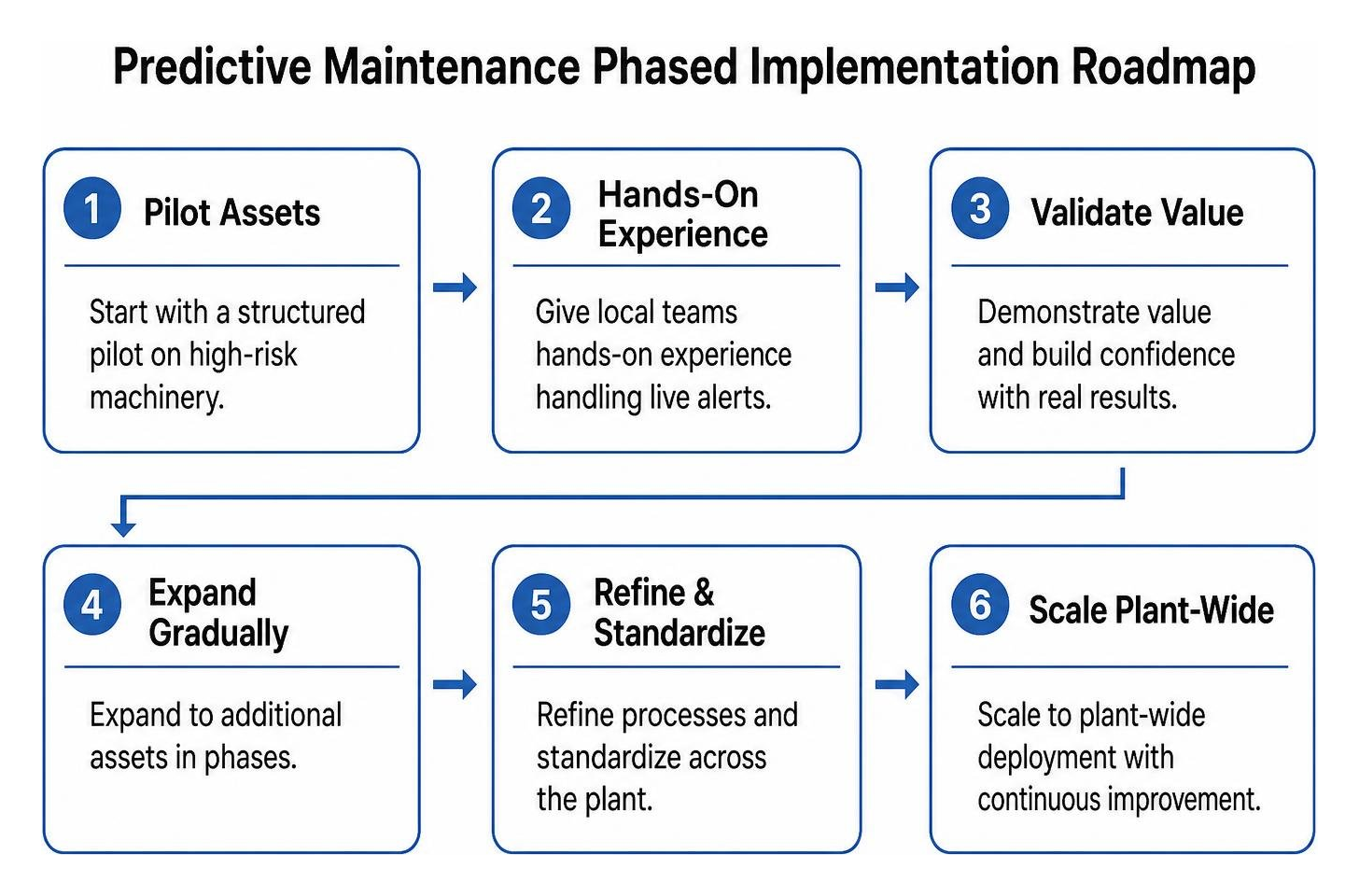
In harsh operational settings, such as heavy processing plants or heavy equipment reliability in mining, starting with a structured pilot protects high-risk machinery while giving local teams hands-on experience handling live alerts.
Deploying IoT Predictive Maintenance Software on Pilot Assets
Begin by selecting 2 to 5 high-criticality assets whose unexpected failure causes clear production bottlenecks or high repair expenses (such as primary slurry pumps, kiln drive gearboxes, or main ventilation fans).
- Mount Multi-Modal Sensors: Install triaxial vibration sensors, surface temperature probes, and current transformers at critical load points and bearing housings.
- Collect Baseline Telemetry (30 Days): Run the machinery across normal operating loads and seasonal conditions to let software algorithms map baseline operational envelopes.
- Establish Anomaly Thresholds: Combine AI baseline limits with ISO vibration standards (such as ISO 10816/20816) to set staged alert tiers (Warning, Critical, Trip).
- Run Human-in-the-Loop Validation: During the first 60 to 90 days, have experienced reliability engineers and maintenance staff review flagged anomalies to tune algorithm sensitivity and eliminate false positives.
Scaling from Single Assets to Enterprise-Wide Operations
Once the pilot proves its value by successfully identifying early-stage defects without false alarms, scale the software across broader production lines:
- Track Core Maintenance KPIs: Quantify improvements by monitoring Mean Time Between Failures (MTBF), Mean Time to Repair (MTTR), Overall Equipment Effectiveness (OEE), and emergency maintenance overtime expenses.
- Integrate Enterprise ERP Systems: Connect the predictive maintenance platform with enterprise ERP software to automate spare parts procurement, track vendor warranty claims, and refine capital budgeting.
- Continuous Model Retraining: As physical repairs, bearing replacements, and motor rewinds occur, log these maintenance events into the software. Tagged maintenance records provide supervised training data, sharpening diagnostic accuracy across the equipment's remaining operational lifecycle.
Frequently Asked Questions About Predictive Maintenance
How does predictive maintenance differ from preventive maintenance?
Preventive maintenance follows fixed calendar intervals or operating hours regardless of an asset's actual physical condition. This leads to two common problems: over-maintaining healthy machinery (which introduces human assembly errors and wastes good spare parts) or under-maintaining equipment that develops early faults between scheduled service windows.
Predictive maintenance uses continuous sensor telemetry and machine learning to track actual machine health in real time. Work is performed only when early component degradation is detected, which typically cuts total maintenance costs by 18% to 31% compared to traditional preventive routines.
What is the typical ROI timeline for IoT condition monitoring?
Most industrial facilities achieve a full return on investment within 6 to 12 months. Financial payback comes from avoiding catastrophic breakdowns, reducing secondary mechanical damage, cutting emergency maintenance overtime, and optimizing spare parts inventory.
In asset-heavy industries where unplanned downtime costs thousands of dollars per hour, catching a single impending bearing seizure on a critical drive line frequently covers the entire software and sensor deployment cost.
Can IoT predictive maintenance integrate with legacy industrial machinery?
Yes. You do not need modern, computer-controlled machinery to implement predictive maintenance. Legacy mechanical equipment—such as older pumps, gearboxes, compressors, and induction motors—can be retrofitted using non-invasive wireless sensor pods and external bolt-on transducers.
Battery-powered or loop-powered industrial sensors measure external housing vibration, surface temperatures, and input line currents. These field readings transmit securely over wireless industrial mesh networks, Bluetooth Low Energy, or cellular gateways directly into the predictive maintenance software without modifying internal machine controls.
Conclusion
Transitioning from reactive firefighting or rigid calendar schedules to condition-based, data-driven maintenance is essential for modern plant reliability. Deploying the right software platform allows maintenance teams to identify early mechanical and electrical faults, automate work orders, extend machinery lifespans, and protect operating margins against unexpected downtime.
HERO Control Systems Ltd. designs, manufactures, and services electronics—PCBs, firmware, and custom replacement boards—while offering industrial repair, IoT software, and engineering training. From our engineering and repair facilities in Lusaka, Zambia, we provide complete, local end-to-end support to help industrial facilities deploy, customize, and maintain robust condition-monitoring infrastructure.
Explore our end-to-end industrial electronics and maintenance services to see how our engineering team can support your plant reliability strategy.