ZTE network cards: repairing BBU and controller boards
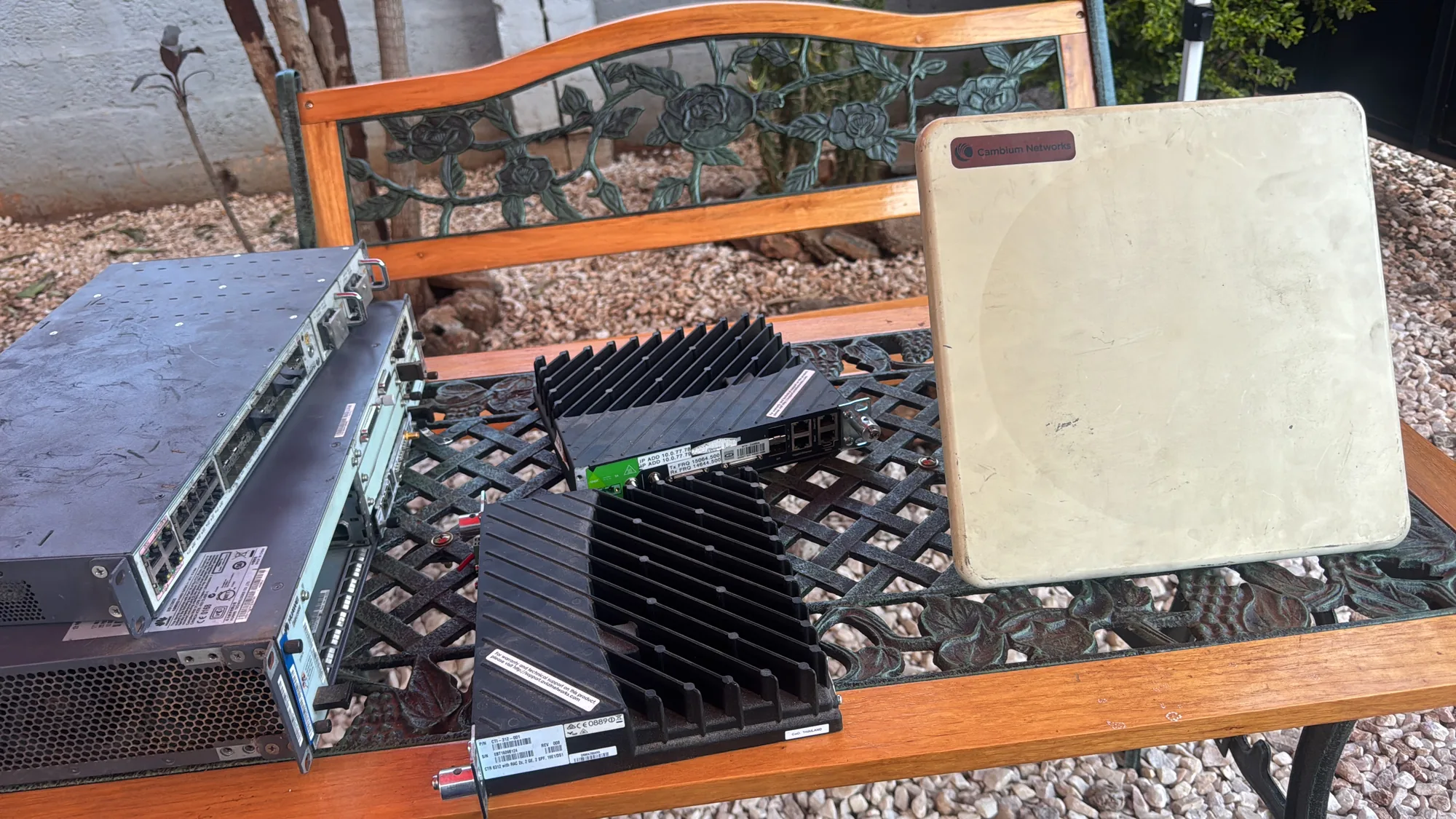
In the equipment rooms of Zambia's mobile networks, racks of ZTE shelves hold plug-in circuit cards. Some sit in the baseband units at base stations. Others sit in the controllers that manage hundreds of sites: the base station controller (BSC) for 2G and the radio network controller (RNC) for 3G. On site these rooms are often called "the core". Strictly, the core network (the switching and subscriber systems) sits deeper still. But for anyone holding a failed card, the problem is the same. It is a dense, multilayer board, it is no longer cheap or quick to replace, and the network needs it back.
The ZTE cards we quote to repair include control and clock cards such as the CC16, and baseband boards such as the BPK, BPN2 and UBPG. They also include the FS3 fabric switch, radio service units (RSU), and controller boards such as the OMP (operation and maintenance), CMP (main processing), SBCX, EGPB and CRP. This article explains how these cards are built, why they fail, and how a repair bench finds the fault at component level.
Why repairing cards matters in Zambia
2G and 3G networks still carry voice and data across much of Zambia, and some of their hardware is no longer manufactured. A new card has to be imported, priced in US dollars, and can take weeks to arrive. Each spare card held in a store is money sitting idle. A card repaired in Lusaka comes back faster, costs less, keeps forex at home, and keeps older equipment in service instead of in a skip.
The anatomy of a telecom card
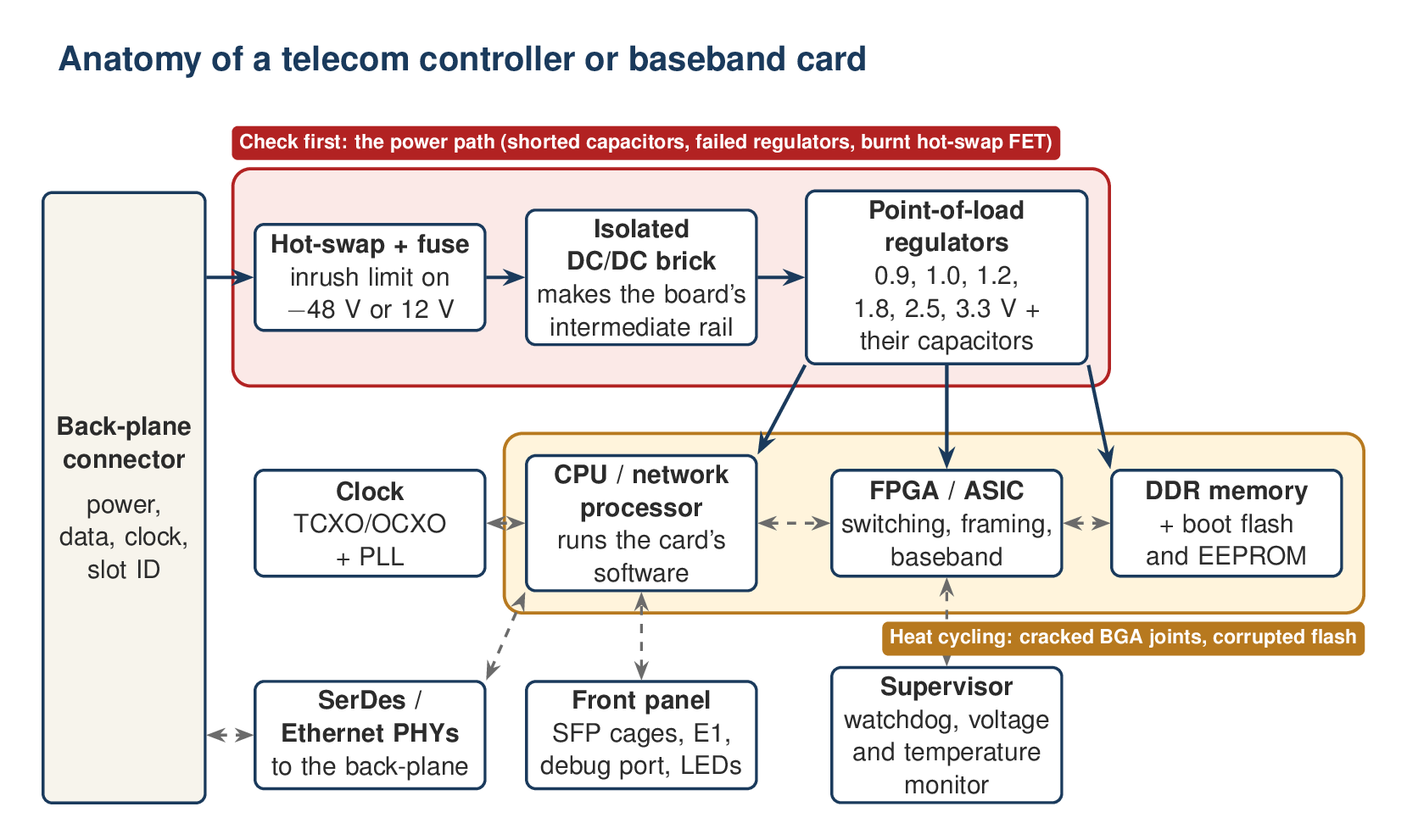
Whatever its job, nearly every card is built from the same blocks:
- The backplane connector brings in power, data, clocks and the slot identity.
- A hot-swap controller and fuse limit the inrush when the card is inserted into a live shelf.
- An isolated DC/DC "brick" converts the shelf supply into the card's intermediate rail.
- Point-of-load regulators make the low voltages the chips need, typically between 0.9 and 3.3 V, each with its own bank of capacitors.
- Processors, FPGAs and ASICs do the card's work, with DDR memory, boot flash and EEPROM beside them.
- Clocks (temperature-compensated or oven-controlled oscillators feeding PLLs) keep the card in step with the network.
- SerDes links and Ethernet PHYs carry traffic over the backplane. Front-panel ports (SFP cages, E1 interfaces, debug ports) connect to the outside.
- A supervisor watches voltages and temperatures and resets the card if its software hangs.
What fails most, and why
1. The power path
Check this first. A failed shelf power supply, a surge or a bad insertion can blow the hot-swap MOSFET or the fuse. Ceramic and tantalum capacitors can fail short and drag a regulator rail to zero, and regulators fail with them. Symptom: the card is dead with no LEDs, or the shelf's power trips the moment the card is inserted. The good news is that power-path faults are usually the most repairable of all.
2. Heat cycling under the big chips
Processors and FPGAs sit on BGA packages, which have hundreds of solder balls underneath. Years of heating and cooling crack those joints. Zambian equipment rooms add their own stress: when load-shedding cuts the mains and the air conditioning stops before the generator starts, rooms heat quickly and then cool again. Symptom: the card works cold but fails warm, or reboots at random.
3. Corrupted flash
Power lost in the middle of a write can corrupt the boot or configuration memory. Symptom: the card boot-loops or stops partway through loading. If the software image is available, this is often recoverable through the serial console.
4. Clocks
Oscillators age or fail. The card boots, but raises clock or synchronisation alarms and will not carry traffic.
5. Mechanical and handling damage
Bent backplane pins show up as a card that works in one slot and not in another. Surge damage on front-panel ports and E1 interfaces shows up as one port dead while the rest of the card runs. Electrostatic discharge from careless handling causes faults that can take months to surface.
How we find the fault
- Intake. Record the serial number, the card type and the operator's alarm history, including which slot it ran in and what happened when it failed.
- Visual inspection. Under magnification, look for burnt parts, bulging capacitors, corrosion, bent or burnt connector pins, and lifted components.
- Cold rail checks. With the card unpowered, measure the resistance of each regulator rail to ground. The best reference is an identical good card. A rail that reads near zero has a short.
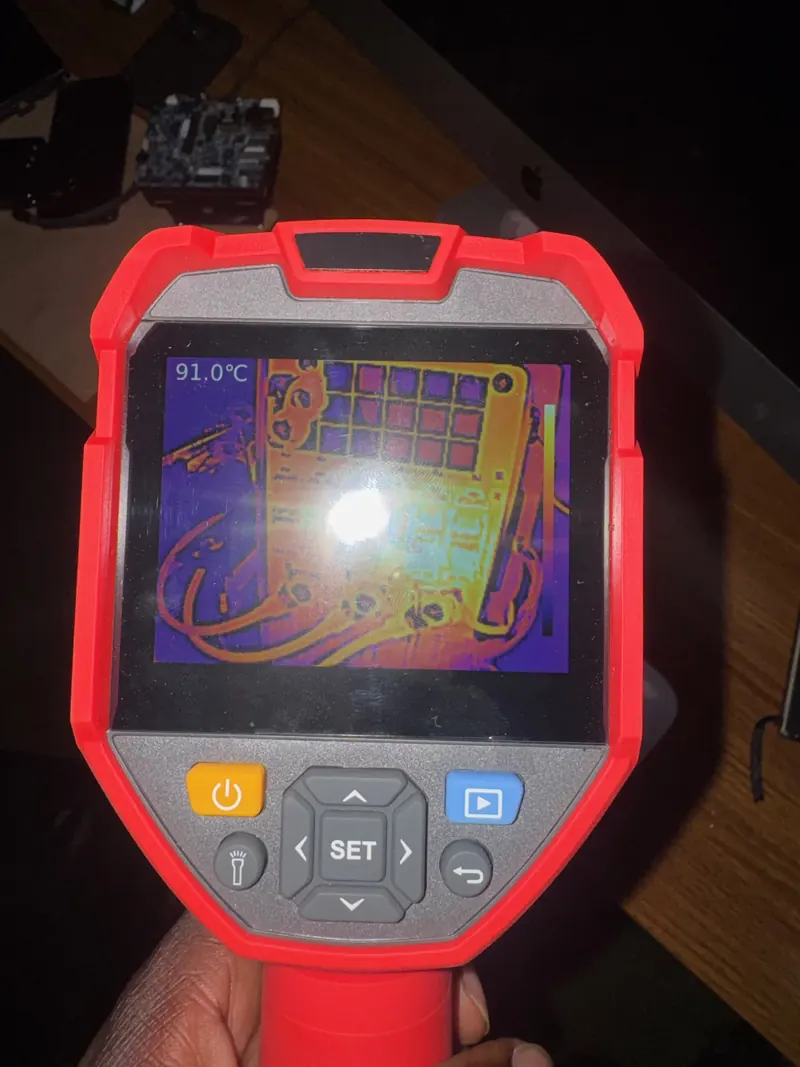
- Find the short with heat. Inject a low, current-limited voltage into the shorted rail and look at the board through a thermal camera. The failed capacitor or chip warms first and shows up in seconds. This one technique turns hours of guesswork into minutes.
- Powered tests on a fixture. Check that the rails come up in the right order, that the clocks are running, and read the boot log through the serial console.
- BGA faults. Pinpoint the fault with controlled heating and cooling. A quick reflow is only a temporary fix; reballing is the proper one. We tell the client exactly which was done.
- Final test in a shelf. In an operator test shelf or a spare slot, confirm that the card is recognised, loads its software, clears its alarms and carries traffic. Then burn it in.
Three rules for anyone handling network cards
- Never test a suspect card in a live shelf. A shorted card can damage the backplane or reset its neighbours, and turn one fault into an outage.
- Treat every card as ESD-sensitive. Use wrist straps, shielding bags and grounded benches, every time.
- Keep the card's identity. Serial numbers, MAC addresses and licence ties must survive the repair, so the card goes back into the network exactly as it left.
Repair or replace?
Power-path faults, failed regulators and capacitors, clocks, ports and connector damage are usually repairable. BGA faults are often repairable, depending on the board. A dead custom ASIC needs a donor board, and some damage is not economic to fix. A bench should give an honest verdict before the work starts.
The skills behind this work, which include reading a board without its schematic, finding faults with heat, and BGA rework, can be taught. They are exactly the skills Zambia needs more of to keep its own networks running. Our training programmes cover electronics design and repair, and thermography.
We repair ZTE and Huawei network cards at component level in Lusaka. See our telecom repair service, or send us your card list.