RRU repair in Zambia: what fails at the top of the tower
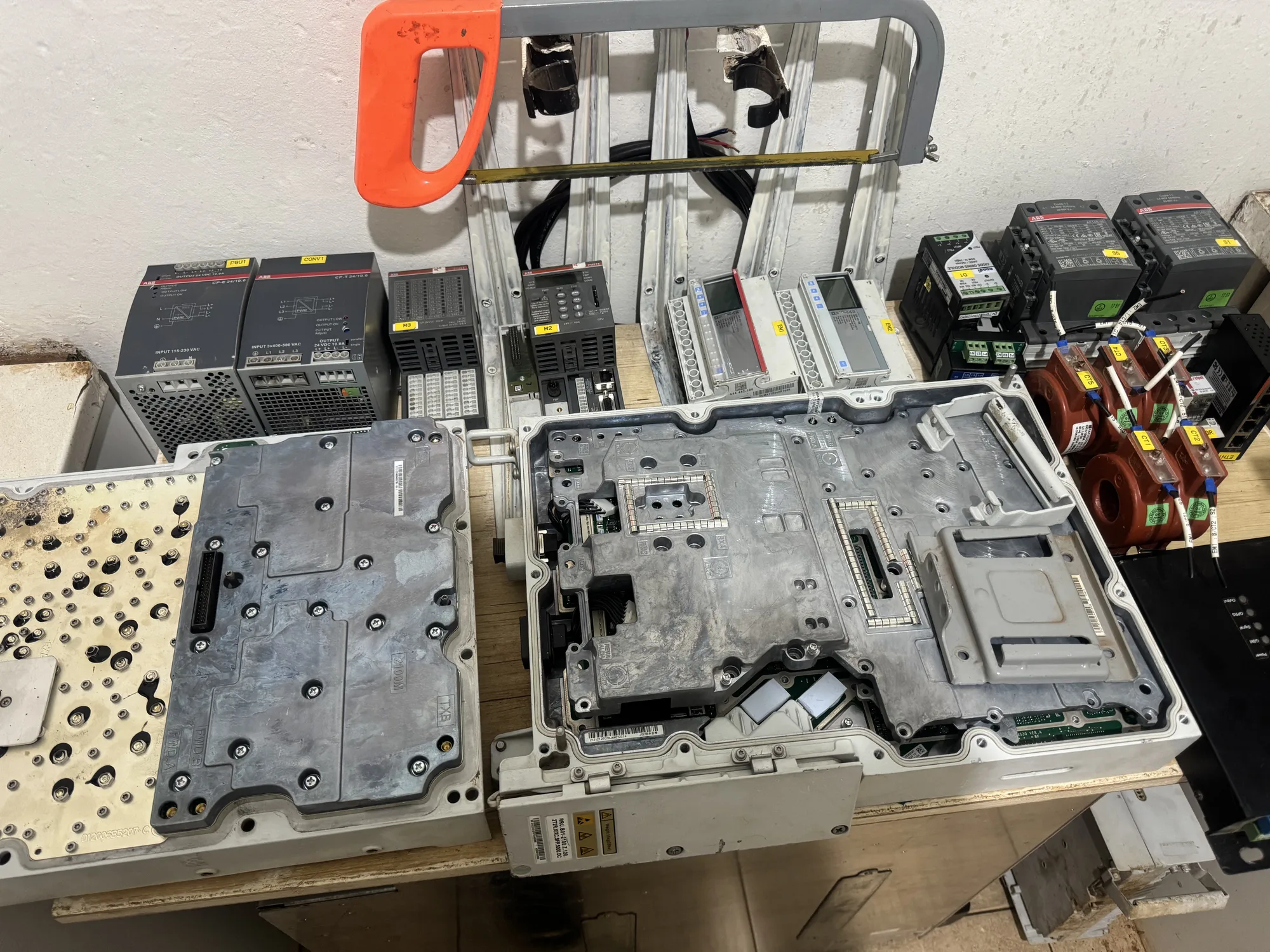
Look up at almost any mobile tower in Zambia and you will see grey boxes clamped behind the antennas. These are remote radio units (RRUs). The baseband unit (BBU) at the foot of the tower sends each one digital data over fibre. The RRU turns that data into radio power for the antenna, and turns the weak signals coming back from phones into data again.
The RRU has the hardest life of anything on a site. It sits outdoors through October heat and summer storms, at the top of the tallest metal structure for kilometres around. Most RRUs have no fans at all: the finned body is the heatsink. When a sector goes quiet and the BBU looks healthy, the RRU is the next suspect.
Operators in Zambia run RRUs from Huawei, ZTE and others. They reach our Lusaka bench in batches. This article explains how an RRU works, what fails most, and how a repair bench tests one without destroying it.
Inside an RRU
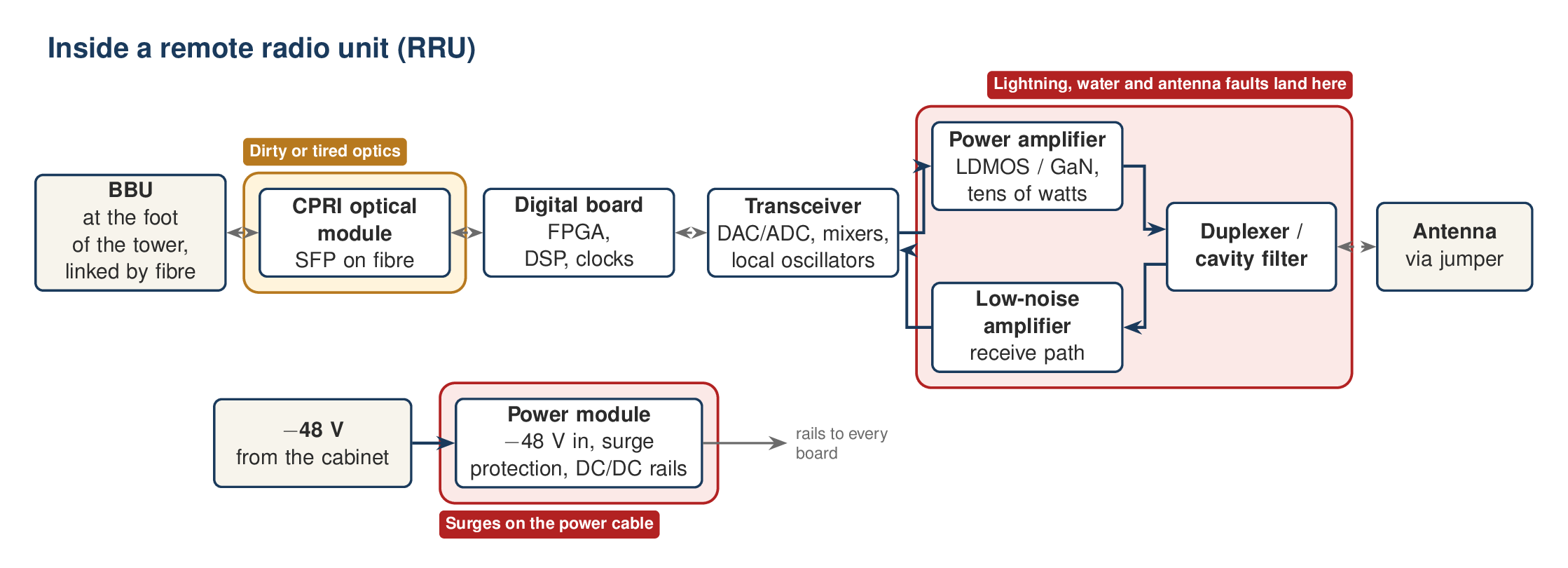
- Power module. Takes −48 V DC from the cabinet below and makes the internal rails. It carries its own surge protection.
- Optical module (CPRI). An SFP transceiver links the RRU to the BBU over fibre.
- Digital board. FPGAs, signal processors and clocks turn the stream from the BBU into signals for the radio.
- Transceiver. Converters, mixers and oscillators move the signal to and from the operator's frequency band.
- Power amplifier (PA). LDMOS or gallium nitride transistors produce tens of watts per transmit branch. This is the most stressed block in the unit.
- Low-noise amplifier (LNA). Lifts the faint signals from phones on the receive path.
- Duplexer or cavity filter. Lets one antenna port transmit and receive at the same time. It is factory-tuned metalwork.
What fails most, and why
1. The power module, from surges
The DC cable runs up the tower beside the feeders and the tower steel. A nearby lightning strike induces a surge along it. Symptom: the RRU is dark, with no LEDs, and the BBU reports that the link to it is lost.
2. The power amplifier, from reflected power
A damaged jumper, water in a connector or a faulty antenna reflects transmit power back into the amplifier. The BBU flags this as a VSWR (voltage standing wave ratio) alarm. If it is ignored, or if lightning arrives through the antenna path, the PA transistors fail. Symptom: low or no output power on one transmit branch, often after weeks of VSWR alarms that nobody cleared.
3. The receive path
Energy coming in through the antenna can destroy the low-noise amplifier while the transmitter carries on working. Symptom: phones can hear the site but the site cannot hear them. The BBU shows high uplink noise or abnormal received-power alarms.
4. Water
Seals age in the sun. Gaskets crack, connector weatherproofing is left unfinished after a site visit, and the first heavy rains find the gap. Water corrodes connector pins and creeps onto boards. In Zambia this failure arrives with the rainy season, roughly November to April.
5. Optics that are not really an RRU fault
A dirty fibre end-face or a tired SFP drops the link between BBU and RRU, and the RRU gets the blame. Always clean and inspect the fibre, and swap the SFP, before taking an RRU down from a tower.
6. Filter damage
A heavy knock can detune the cavity filter. This is rare but serious. Without a vector network analyser and the factory tuning data, the filter is replaced rather than repaired.
Diagnose before you climb down
- Read the BBU's alarm history for that RRU: power, link, VSWR and receive alarms each point to a different block.
- Measure the −48 V at the RRU end under load. Long DC cables drop voltage, and a marginal supply looks like a faulty radio.
- Clean and inspect both fibre ends, and swap the SFPs.
- Check the jumpers and connectors for water before you condemn the amplifier.
An RRU brought down and sent to a workshop costs a tower climb, a sector outage and often a spare that someone else needed. Ten minutes of checks first saves all three.
How a repair bench tests an RRU
An RRU cannot be tested with a multimeter and a laptop. A proper bench needs:
- a −48 V DC supply that can deliver the RRU's full current, with current limiting for the first power-up;
- a BBU or a CPRI test set, because the RRU will not transmit until it is commanded to;
- high-power dummy loads and attenuators on every antenna port, rated above the amplifier's output;
- a spectrum analyser and an RF power meter.
The sequence:
- Intake. Record the serial number, the operator's alarm history and any signs of water or burning, and photograph the unit.
- Open and inspect. Look for corrosion, burnt protection parts in the power module, and heat damage around the amplifier stages.
- Power module first. Repair the input protection and DC/DC stages, then power up under current limit and check every internal rail.
- Bring up the link. Connect the BBU or test set over fibre and confirm that the RRU is recognised and reports no hardware alarms.
- Transmit into loads only. With every port terminated, transmit at reduced power, then at rated power. Measure output power and the spectrum on each branch.
- Check the receive path. Confirm that the noise floor is normal on every branch.
- Seal and burn in. Fit new gaskets, close the unit and run it for hours before it is signed off.
Safety note: never let an RRU transmit into an open port. The amplifier can be destroyed in seconds, and near-field RF energy at these power levels is a real hazard to people. Every port must be terminated into a tested load before power is applied.
Repair or replace?
Power-module faults, failed amplifier transistors, damaged receive paths and corroded connectors are worth repairing. A cavity filter detuned by impact, or a digital board badly damaged by water, may not be. A good bench will tell you before work starts.
Preventing RRU failures on Zambian sites
- Fit surge protection on the DC lines at both the top and the bottom of the tower, and bond it to the tower's earthing.
- Earth the feeders and jumpers with proper grounding kits.
- Weatherproof every connector with self-amalgamating tape and a final protective layer, and leave drip loops so water runs off before it reaches the unit.
- Inspect the weatherproofing before the rains, and after any site visit where connectors were opened.
- Act on VSWR alarms within days, not months. A VSWR alarm is a cheap jumper fault on its way to becoming an expensive amplifier fault.
Every RRU repaired in Lusaka is one less import paid in US dollars and one less unit waiting weeks at the border. See our telecom repair service, or talk to us about a batch of failed units.