Repair is the circular economy that pays for itself
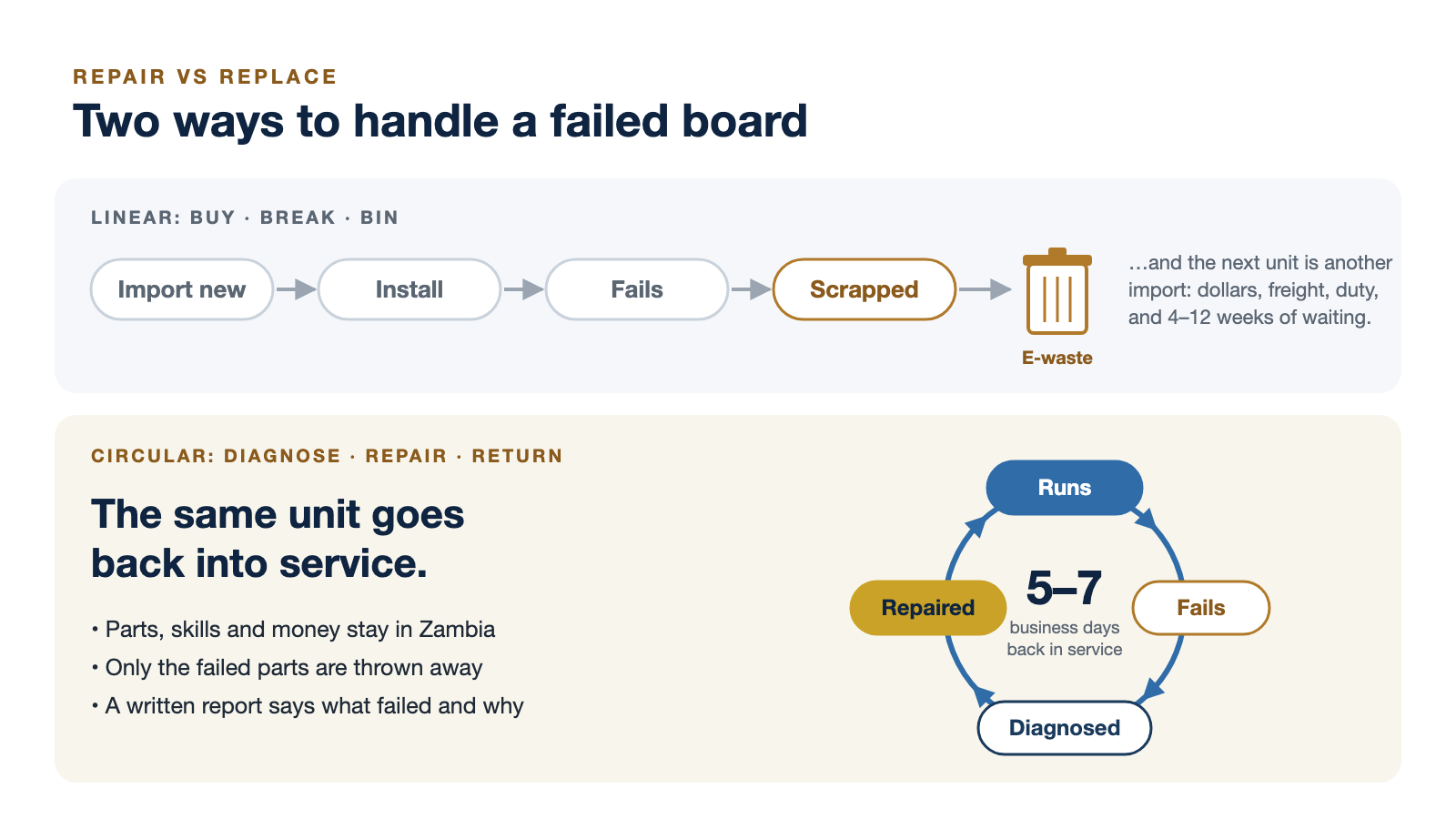
Most organisations already practise the circular economy without calling it that. Every time a failed drive, rectifier or control board is repaired instead of replaced, a machine goes back to work, the money stays in the business and one less unit goes to the dump. The case for repair is usually made in kwacha. It is just as strong in ESG terms.
The cost case: what replacing really costs
The price of a new unit is only the start. For most industrial and telecom electronics in Zambia, a replacement is an import, and an import brings its own costs.
| Import a replacement | Repair in Lusaka | |
|---|---|---|
| You pay for | A complete new unit, in foreign currency | The failed parts and the labour to fix them |
| On top of that | Freight, import duty, exchange-rate risk | Component costs only, not a whole unit's freight and duty |
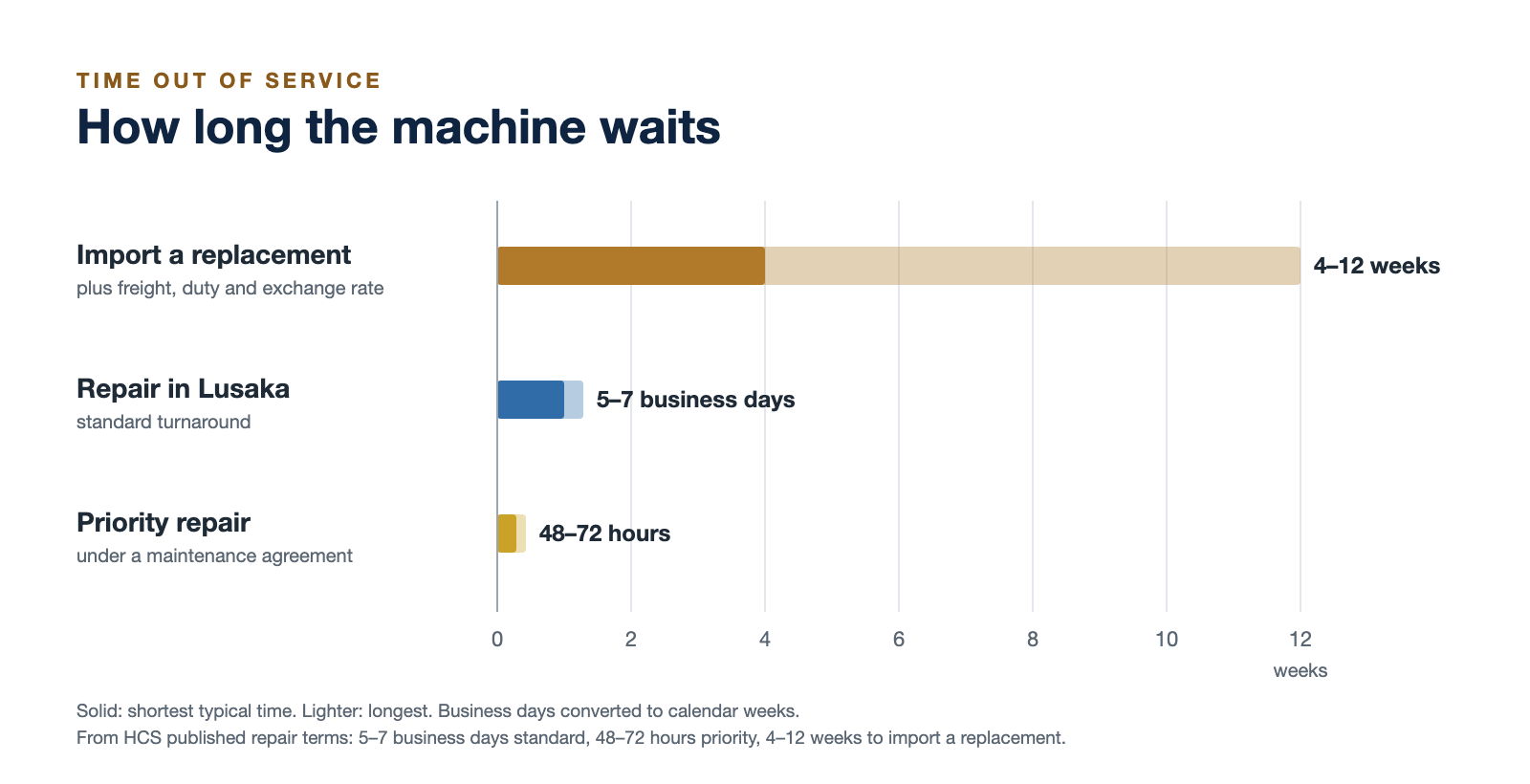
| Out of service | Typically 4–12 weeks | 5–7 business days, or 48–72 hours on priority |
| The failed unit | Scrapped | Back in service |
| What you learn | No root-cause analysis | A written report: what failed, and why |
| If it can't be fixed | Not applicable | We say so: flat K950 assessment fee, no repair fee |
| Warranty | The manufacturer's terms | 6-month workmanship warranty |
The biggest cost on that list often has no invoice: downtime. A pump station, mill or tower site that waits weeks for a part can lose more in lost output than the part itself costs. Repair's first saving is time.
The cheapest machine is usually the one you already own, working again.
The environmental case: e-waste you never create
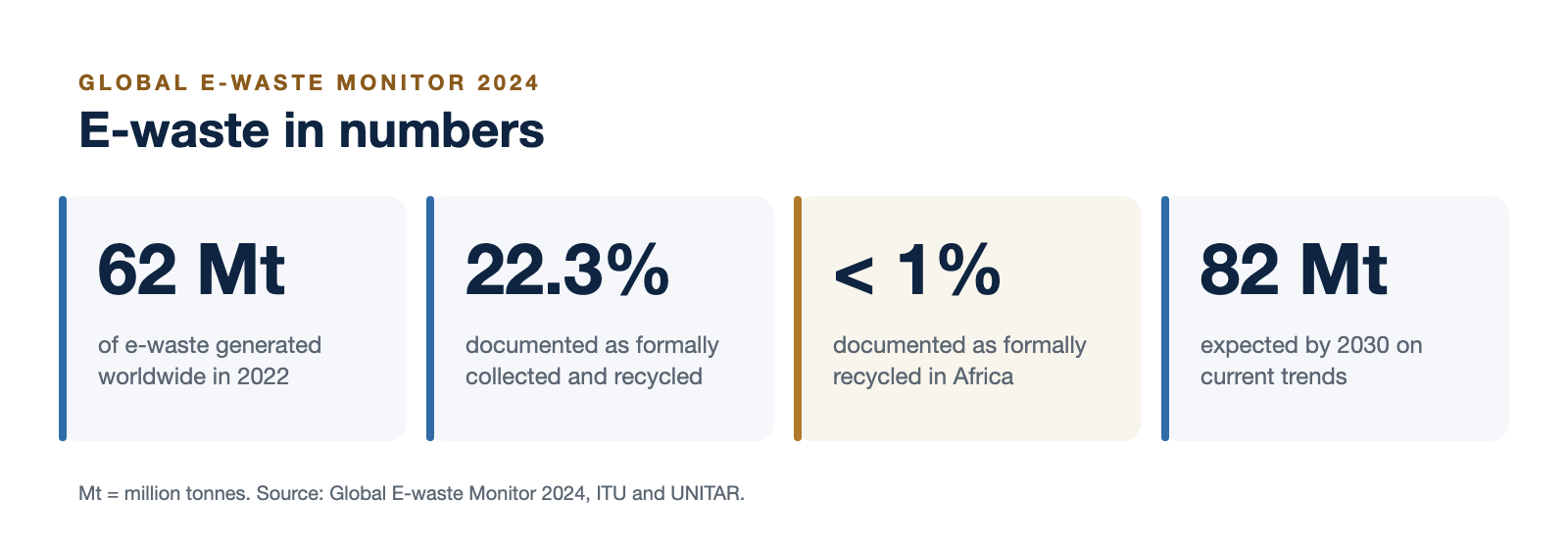
Electronic waste is growing five times faster than documented recycling. The Global E-waste Monitor 2024, published by ITU and UNITAR, counted 62 million tonnes of e-waste generated worldwide in 2022, of which only 22.3% was documented as formally collected and recycled. In Africa the documented figure was below 1%. On current trends the world will generate 82 million tonnes a year by 2030.
Recycling is the last resort, and in most of Africa it barely exists yet. The better answer is to create less e-waste in the first place. A repaired unit is not e-waste: only the failed components are thrown away, not the whole unit. And no new unit has to be manufactured and shipped in to take its place.
The ESG case: repair in the language of your report
Lenders, investors and large customers increasingly ask companies to report on environmental, social and governance performance. Repair gives you something concrete to report under all three.
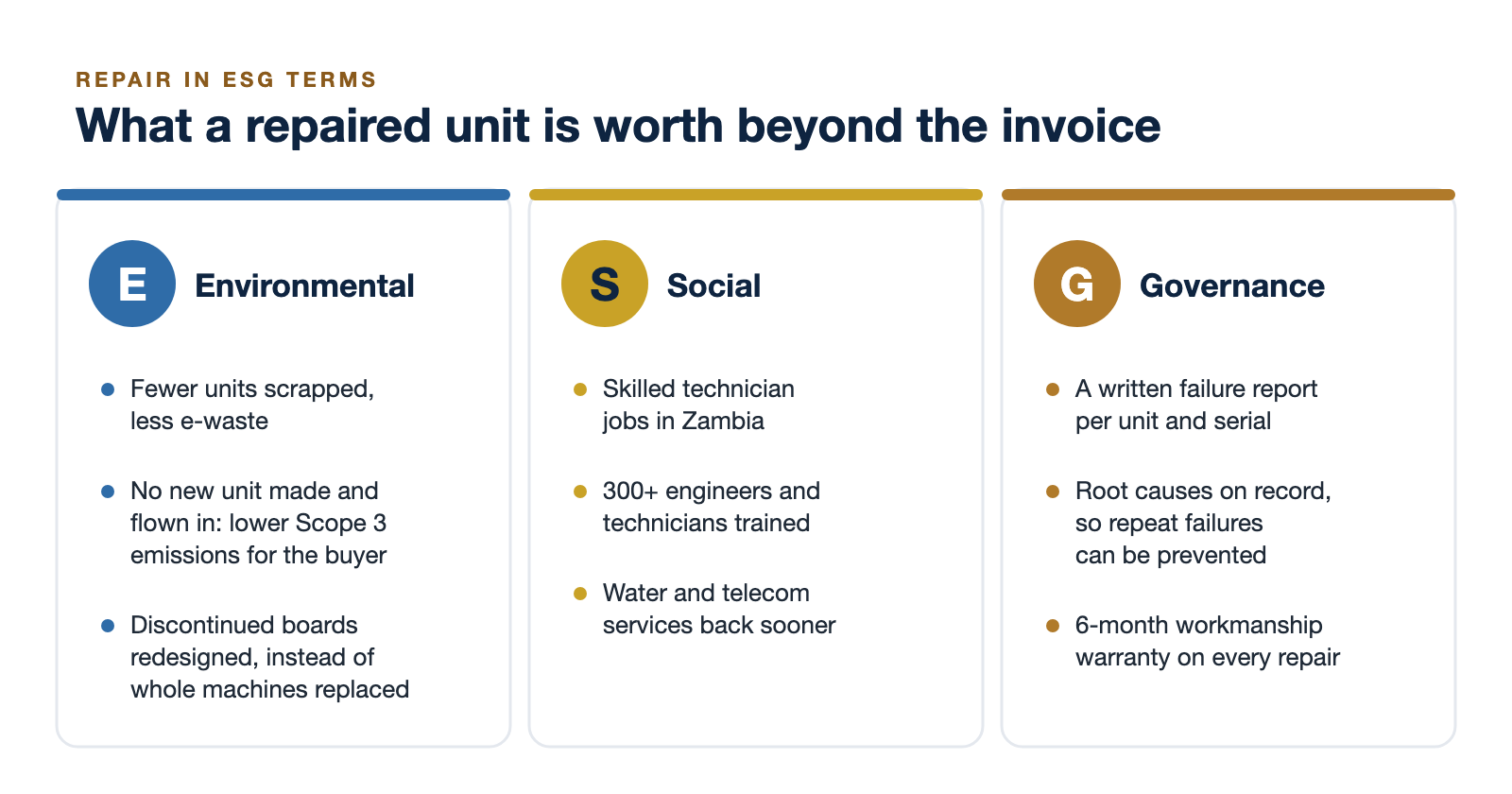
- Environmental. In greenhouse-gas accounting under the GHG Protocol, the emissions from making the equipment you buy, and from transporting it to you, fall in your Scope 3. A repair avoids a new unit's manufacturing and shipping for that failure. Count the units repaired instead of replaced, and the equipment kept out of the waste stream.
- Social. Repair is skilled local work: diagnosis, component replacement, testing and commissioning, done by Zambian technicians. We have trained more than 300 engineers and technicians, and essential services such as water and telecoms get back into operation sooner.
- Governance. Every unit we repair comes back with a written failure report by serial number. That is an audit trail for maintenance spend, a record of root causes, and evidence for your risk register that you are less exposed to import delays and exchange-rate swings.
Repair, redesign or replace: an honest decision
Repair-first does not mean repair at any cost. The decision is made after diagnosis, and it has three possible answers.
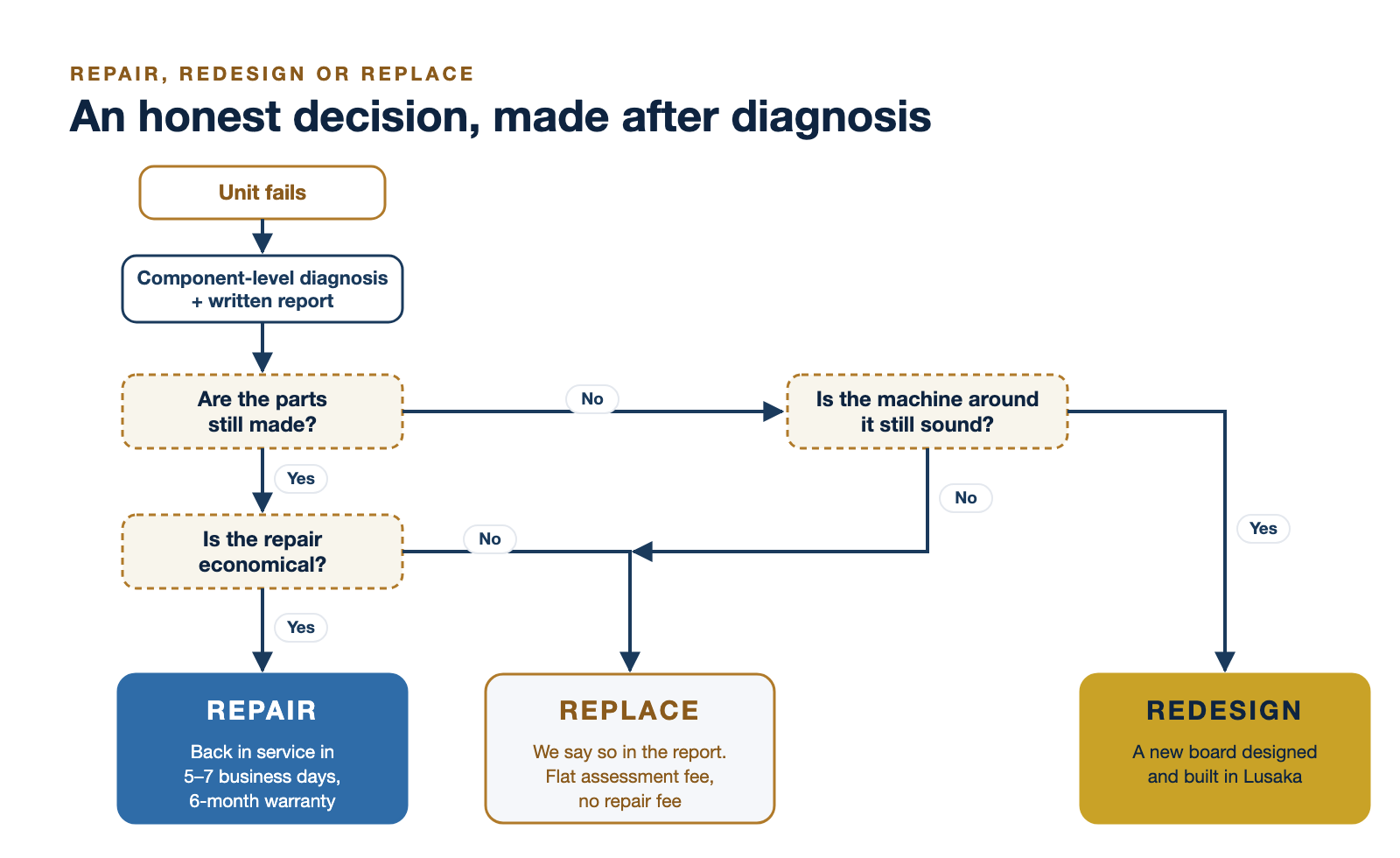
- Repair when the parts are available and the repair is economical. The unit is back in 5–7 business days with a 6-month workmanship warranty.
- Redesign when the parts or the board are no longer made, but the machine around them is sound. At Lusaka Water we designed and built a replacement for a soft-starter control card that had been discontinued worldwide; it has run since February 2026 with zero failures. Read the case.
- Replace when a repair is not economical or the equipment has reached the end of its life. We say so in the report, charge a flat assessment fee of K950 and no repair fee.
The world is moving the same way
Repair is becoming policy. The European Union adopted Directive (EU) 2024/1799, its "right to repair" law, in June 2024, and member states had until 31 July 2026 to bring it into national law. Zambia has had Extended Producer Responsibility Regulations since 2018 (Statutory Instrument No. 65 of 2018). Organisations that build repair into their maintenance now will be ahead of where regulation is heading.
How to make repair part of your maintenance and your ESG report
- Keep failed boards and units. Even a burnt board still shows how its circuit was built, and it is the fastest route to a repair or a redesign.
- Ask for a diagnosis before any replacement quote, with a written report for each unit.
- Write repair-first into procurement: replace only when a repair is shown to be uneconomical or unsafe.
- Agree priority turnaround for critical equipment under a maintenance agreement.
- Count it. Units repaired instead of replaced, weeks of downtime avoided and equipment kept out of the waste stream are simple numbers for an ESG report.
- Inspect before it fails. A thermal imaging survey finds hot connections and overheating parts while they are still cheap to fix.
Before your next failed unit goes in a box for another country, send us a photo of it and its nameplate on WhatsApp at +260 974 546 632, or email sales@hcsys.co. More on industrial repair, telecom repair and electronics design.